Zelensky Says US Intelligence Sharing “Works Now” as Trump Envoy Meets Putin in Russia
Ukrainian President Volodymyr Zelensky says US intelligence sharing has resumed as envoy Steve Witkoff meets Vladimir Putin in Russia to discuss ending the war in Ukraine.
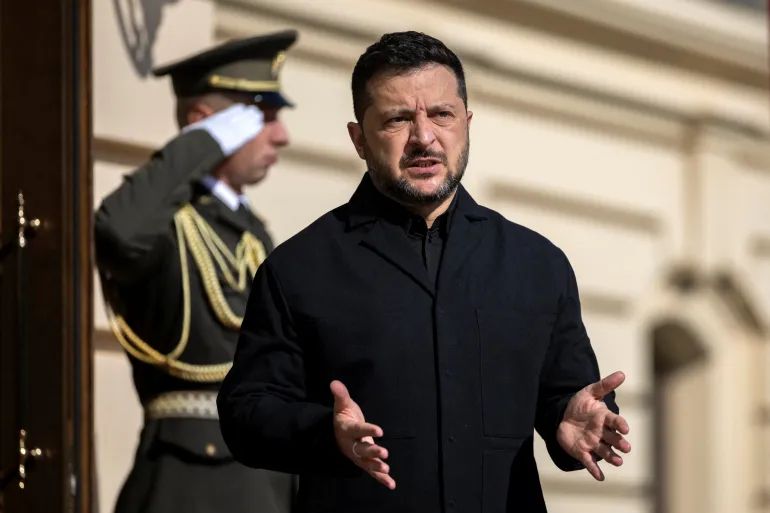
Ukrainian President Volodymyr Zelensky has welcomed the restoration of critical US intelligence sharing with Kyiv, saying the system “works now” as Washington intensifies diplomatic efforts to end Russia’s war against Ukraine.
The announcement came after Zelensky met US special envoy Steve Witkoff in Oslo, Norway, on Tuesday, October 20, 2026. Witkoff subsequently travelled to Russia for discussions with Russian President Vladimir Putin in St Petersburg on Wednesday, October 21.
The diplomatic engagements have raised hopes of renewed negotiations, even as disagreements persist over the terms of a possible settlement, Ukraine’s security guarantees and the future of Western military support.
The restored intelligence cooperation includes advance warnings about Russian missile attacks, which Ukrainian authorities rely on to alert civilians and coordinate defensive measures. (The Guardian)
US intelligence sharing resumes after tensions
Zelensky’s announcement follows a period of uncertainty over the extent of American intelligence assistance to Ukraine. Kyiv had complained that it was no longer receiving timely warnings about incoming Russian ballistic missile attacks, leaving civilians and military units facing additional risks.
The Ukrainian president said the renewed flow of early-warning intelligence was particularly important because it enabled authorities to identify approaching threats and give people more time to seek shelter.
“We are thankful that intelligence works now,” Zelensky said during his visit to Norway, stressing the importance of the information for children, adults and civilians.
The restoration followed discussions with senior American officials, including US Secretary of State Marco Rubio. Washington, however, disputed claims that it had deliberately withdrawn intelligence support as a means of pressuring Ukraine into accepting a peace agreement.
The development offers a significant, if limited, improvement in US-Ukraine cooperation at a time when Kyiv remains concerned about the reliability of American military assistance.
The Associated Press reported that Ukraine had experienced a lapse in advance warnings before the restoration was announced. The renewed cooperation could improve civilian protection, although it does not by itself resolve wider disagreements over weapons deliveries and battlefield support (Associated Press)
Witkoff meets Putin over possible peace deal
Witkoff’s meeting with Putin represents another attempt by the administration of US President Donald Trump to establish a path towards ending the conflict.
The envoy travelled to Russia after discussions with Zelensky and European representatives in Oslo, where the parties examined possible approaches to a settlement, including ceasefire arrangements, security guarantees and Ukraine’s post-war reconstruction.
Russian news agencies reported on Wednesday that Putin met Witkoff in St Petersburg. During the discussions, the Russian president reportedly thanked Trump for his efforts to resolve the conflict and indicated Moscow’s interest in restoring economic relations with Washington.
Witkoff expressed hope that Putin would consider restarting trilateral negotiations involving Russia, the United States and Ukraine.
He also indicated that there was a basis for discussing a ceasefire, although the meeting did not immediately produce a confirmed comprehensive peace agreement.
The talks are taking place against the backdrop of continued fighting, mutual distrust and sharply differing expectations about the conditions required to end the war.
Zelensky insists Ukraine must shape its future
Despite welcoming renewed American intelligence cooperation, Zelensky has made clear that Ukraine must participate directly in negotiations concerning its territory, sovereignty and long-term security.
The Ukrainian leader has expressed support for a trilateral summit involving himself, Trump and Putin, arguing that certain difficult questions can only be resolved at the highest political level.
He has also warned against any arrangement in which major powers determine Ukraine’s future without Kyiv’s involvement.
The position reflects Ukraine’s concern that a settlement negotiated principally between Washington and Moscow could impose concessions on the country without adequately addressing its security needs.
Zelensky has indicated that any final agreement would need to be acceptable to Ukraine and receive the necessary domestic approval.
Kyiv is particularly concerned about preventing another war after a ceasefire. Ukrainian officials want credible security guarantees that would reduce the risk of Russia launching another invasion once hostilities formally end.
The issue is likely to remain one of the most difficult elements of negotiations because Moscow and Kyiv have fundamentally different positions on the conflict’s origins, territorial questions and Ukraine’s future security arrangements.
Starshield and military assistance remain concerns
While the restoration of intelligence warnings represents progress, other aspects of US support remain unresolved.
Zelensky has raised concerns about restricted access to Starshield, the military-grade satellite communications service associated with SpaceX. Ukraine relies on satellite connectivity for important military communications and operational coordination.
The Ukrainian president has also stressed the need for additional air-defence capabilities, particularly interceptor missiles used to protect cities and critical infrastructure against Russian attacks.
Patriot air-defence systems have become especially important to Ukraine because of Russia’s continued use of missiles and drones against populated areas and strategic facilities.
American officials have disputed allegations that Washington deliberately withheld military assistance to force Kyiv into accepting a settlement.
Nevertheless, uncertainty over the availability and timing of US support remains a major concern for Ukraine as European governments seek to sustain assistance and strengthen their own defence commitments.
The resumption of intelligence sharing should therefore be viewed as one element of a broader and still-contested relationship rather than evidence that all disagreements between Washington and Kyiv have been resolved.
Russia-Ukraine war continues despite diplomatic efforts
The diplomatic initiatives are unfolding as Russian attacks continue to threaten Ukrainian civilians and infrastructure.
For Kyiv, an effective ceasefire would need to do more than temporarily stop the fighting. It would also have to address the security vulnerabilities that could allow hostilities to resume.
For Washington, the challenge is to persuade both sides to accept a negotiated framework despite their conflicting objectives.
Moscow has continued to signal that any settlement must account for its demands, while Ukraine insists that peace cannot come at the expense of its sovereignty and future security.
European leaders have also emphasised the importance of their participation in the peace process, arguing that the consequences of the conflict extend beyond Ukraine and Russia.
The Oslo discussions brought together Ukrainian and American representatives alongside European partners, including Norwegian Prime Minister Jonas Gahr Støre and Finnish President Alexander Stubb.
Their involvement underlines the international dimension of negotiations and the importance of coordinating diplomatic initiatives with longer-term security arrangements.
What happens next?
Witkoff’s discussions with Putin could help establish whether the latest proposals have sufficient support to move towards a ceasefire or renewed trilateral negotiations.
However, the restoration of intelligence sharing does not guarantee a breakthrough. The parties must still overcome disagreements about security guarantees, territorial issues, military support and the terms of a lasting settlement.
For Ukraine, reliable intelligence remains essential to protecting civilians while diplomatic efforts continue. For the United States, the immediate challenge is to turn renewed engagement into meaningful progress without leaving critical questions about Ukraine’s future unanswered.
Zelensky’s declaration that US intelligence sharing “works now” marks a welcome development for Ukraine’s defensive preparedness. But whether Witkoff’s meeting with Putin produces a credible route to peace will depend on the willingness of Moscow, Kyiv and Washington to address the fundamental disagreements keeping the war alive.
The next major test will be whether the current diplomatic momentum leads to substantive negotiations and a settlement that Ukraine considers secure and sustainable.