Ukrainian Strikes Kill Six in Russia as Belgorod Region Comes Under Missile Attack
Ukrainian missile strikes killed six people and wounded four others in Russia’s Belgorod region, according to the acting governor, as Moscow and Kyiv intensify long-range attacks.
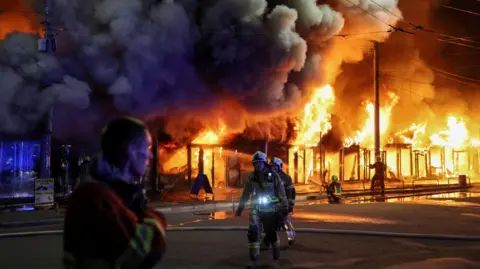
Six people have been killed and four others wounded following Ukrainian missile strikes on Russia’s Belgorod region, according to the region’s acting governor, Alexander Shuvaev, in the latest escalation of long-range attacks between Moscow and Kyiv.
The strikes occurred overnight into Monday, August 17, 2026, as Ukraine and Russia continued an increasingly intense exchange of missiles and drones. The latest attack came only hours after Ukraine launched what Russian authorities described as one of the largest aerial assaults on Russian territory since the war began. (Al Jazeera)
The deaths underscore the growing risks faced by civilians in Russian regions bordering Ukraine, where cross-border attacks have become increasingly frequent as the war enters another prolonged phase.
Six killed in Belgorod missile strike
According to Shuvaev, the Ukrainian attack struck the village of Koloskovo in the Valuysky municipal district, around 24 kilometres from the Ukrainian border.
The acting governor said six people died and four others were injured. Among those wounded was a 14-year-old child. Russian authorities described the incident as a Ukrainian missile attack, although independent verification of the circumstances and the exact weapons used was not immediately available. (The Moscow Times)
The attack added to a rapidly growing civilian casualty toll from cross-border strikes as both Russia and Ukraine increasingly rely on long-range weapons to hit targets far from the front line.
The Belgorod region has been repeatedly targeted during the conflict because of its proximity to Ukraine and its importance as a logistical area for Russian military operations.
Attack follows massive Ukrainian drone assault
The Belgorod missile strike came shortly after an enormous Ukrainian drone offensive against Russia.
Russian authorities said Ukraine launched hundreds of drones overnight, targeting Moscow and several other regions. Russia's Defence Ministry said it intercepted 822 Ukrainian drones, making the attack one of the largest aerial assaults of the war. (New York Post)
The offensive caused deaths and damage in several locations.
In the Moscow region, an 83-year-old man was killed after a drone strike hit a warehouse belonging to Wildberries, one of Russia's largest online retailers. The incident occurred in Podolsk, south of Moscow, while other facilities were also damaged.
The attacks demonstrated Ukraine's growing ability to conduct long-range strikes deep inside Russian territory.
Ukraine expands long-range attacks
Ukraine has increasingly used drones and missiles to strike targets inside Russia, particularly facilities it says contribute to Moscow's war effort.
Kyiv has targeted military-industrial facilities, energy infrastructure, oil facilities and logistics centres. Ukrainian officials argue that attacking such sites can disrupt Russia's ability to produce weapons and supply forces fighting on the battlefield.
The latest offensive reportedly targeted several warehouses operated by Wildberries. Ukraine has accused the company and other logistics networks of facilitating Russian military supply chains.
The Guardian reported that Ukrainian forces claimed to have targeted 10 major Wildberries warehouses, with seven reportedly disabled. The attacks demonstrate Kyiv's strategy of attempting to undermine Russia's military logistics and economic infrastructure far behind the front line. (The Guardian)
Moscow, however, has repeatedly condemned such attacks as acts of terrorism and says Ukraine is deliberately targeting civilians.
Russia retaliates with attacks across Ukraine
The escalation has not been one-sided.
While Ukrainian drones and missiles struck Russia, Russian forces launched another series of attacks against Ukrainian cities and infrastructure.
Ukrainian officials reported deaths and injuries in several regions, including Zaporizhzhia, Kryvyi Rih and Sumy. Russian strikes also caused damage in Kyiv, where a fire broke out at a major book market. (The Times)
Reuters reported that Russian strikes in Ukraine included attacks on military-related facilities and industrial infrastructure earlier in the week. Moscow has continued to argue that its strikes are directed at military and strategic targets rather than civilians.
The continuing exchange highlights the increasingly dangerous nature of the conflict, with both sides seeking to inflict damage deep behind the other's defensive lines.
Civilian casualties continue to rise
The latest deaths in Belgorod add to concerns over the increasing civilian toll of the war.
Although the front line has remained relatively static in some areas, the conflict has increasingly shifted toward long-range missile and drone warfare.
This has expanded the geographical reach of the fighting.
Russian border regions such as Belgorod, Kursk and Bryansk have experienced repeated Ukrainian drone and missile attacks, while Ukrainian cities remain vulnerable to Russian bombardment.
The result is a war in which civilians thousands of kilometres from active battlefields can increasingly find themselves exposed to aerial attacks.
Growing pressure on air defences
The scale of recent attacks has also highlighted the pressure facing both countries' air-defence systems.
Russia's Defence Ministry claimed that hundreds of Ukrainian drones were intercepted during the latest offensive. However, the reported casualties and damage show that some weapons penetrated defensive systems.
Ukraine faces similar challenges.
Russia possesses a large arsenal of cruise missiles, ballistic missiles and drones and has repeatedly launched waves of attacks against Ukrainian cities and infrastructure.
The ability of each side to overwhelm or evade the other's air defences has therefore become a major component of the war.
War intensifies despite diplomatic uncertainty
The latest escalation comes at a time when international efforts to find a diplomatic solution to the Russia-Ukraine conflict remain uncertain.
While diplomatic initiatives have periodically raised hopes of negotiations, military activity has continued unabated.
Instead of reducing attacks, both sides have invested heavily in drones, missiles and other long-range weapons.
Ukraine has increasingly developed its own weapons capabilities to reduce dependence on foreign supplies, while Russia has continued expanding its drone production and missile capabilities.
The result is a conflict that is becoming increasingly technological and capable of reaching targets far from the battlefield.
What happens next?
The deaths in Belgorod are likely to further harden attitudes on both sides as Russia and Ukraine continue their cycle of retaliation.
For Russia, attacks on its territory provide another justification for striking Ukrainian infrastructure. For Ukraine, long-range attacks are increasingly viewed as necessary to disrupt Russia's military-industrial capacity and reduce its ability to sustain the war.
But the immediate human cost remains significant.
The killing of six people in Belgorod, including the latest civilian casualties from the wider exchange of attacks, illustrates how the war continues to affect communities on both sides of the border.
As Ukraine develops more capable long-range weapons and Russia maintains its own missile and drone arsenal, attacks deep inside each country are likely to remain an important feature of the conflict.
For civilians in Belgorod and other border regions, the latest attack is another reminder that the Russia-Ukraine war is no longer confined to the front lines. Its consequences increasingly reach cities, villages and communities far from the battlefield.