Ukraine and Russia Trade Strikes on Key Bridges as War Escalates, Disrupting Military Logistics and Civilian Transport
Ukraine and Russia have intensified attacks on strategic bridges, with Russian strikes hitting two major Kyiv bridges and Ukrainian drones targeting the Crimea Bridge and key Russian logistics routes, disrupting transportation and military supply lines.
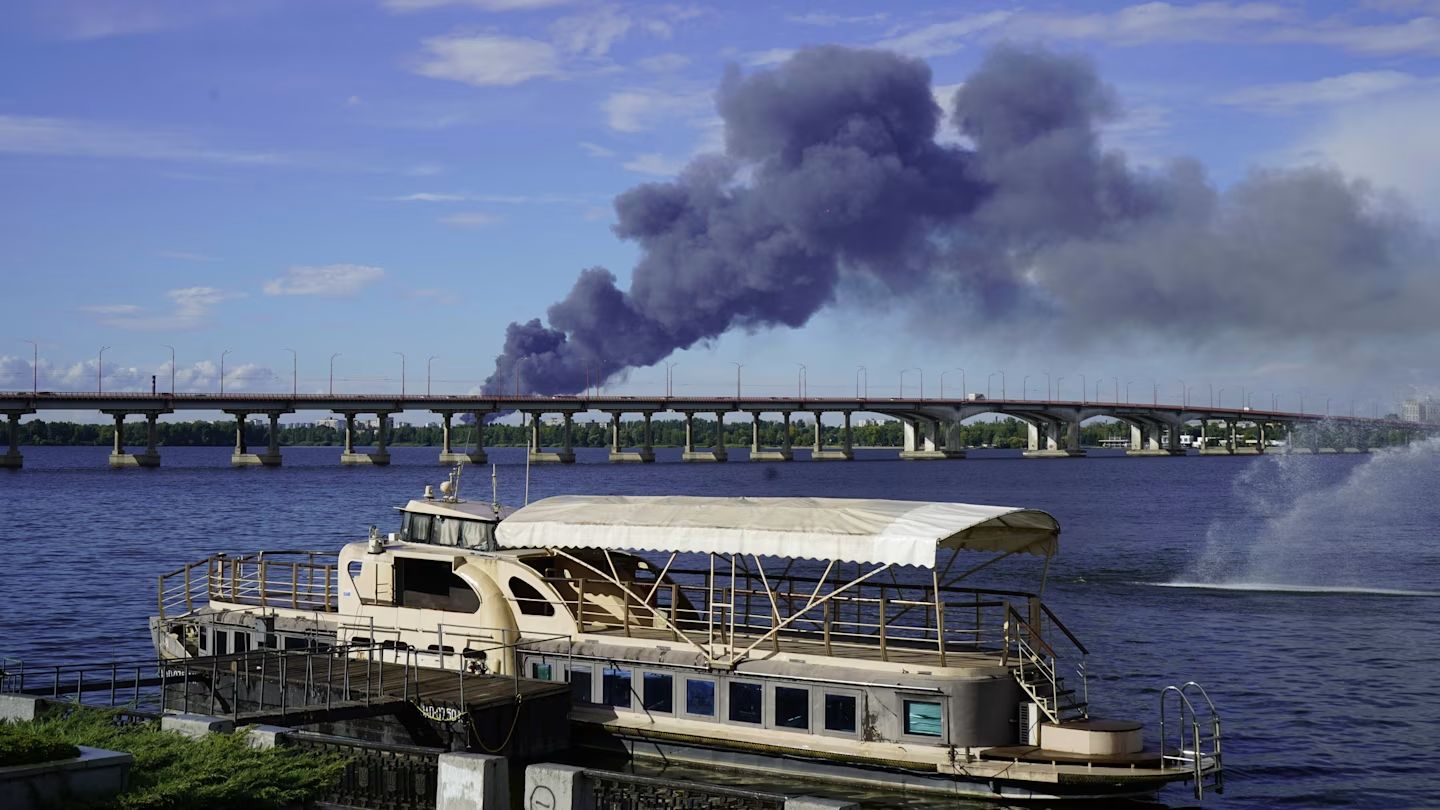
The war between Ukraine and Russia has entered another dangerous phase following a series of attacks on strategically important bridges in both countries, raising fresh concerns about military logistics, civilian transportation and the security of critical infrastructure.
In a renewed exchange of strikes, Russian forces attacked two major bridges across the Dnipro River in Ukraine's capital, Kyiv, while Ukrainian forces targeted the strategically significant Kerch Bridge linking Russia to occupied Crimea for consecutive days.
The latest attacks, reported on November 17, 2026, demonstrate how both sides are increasingly targeting infrastructure that supports military movements, supply operations and economic activities as the conflict approaches its fifth year.
The attacks have also disrupted civilian movement, with transportation restrictions, electricity interruptions and water supply problems reported in affected areas.
Russian Strikes Hit Two Major Bridges in Kyiv
Russian forces launched attacks against two important bridges in Kyiv late Monday, November 16, according to the city's mayor, Vitali Klitschko.
The affected structures were the Northern Bridge and Southern Bridge, both of which cross the Dnipro River and serve as important transportation connections between different parts of the Ukrainian capital.
Klitschko announced the attacks in a statement on Telegram, explaining that preliminary information indicated that both bridges had been hit.
The strikes also affected other infrastructure, partially damaging the city's subway system and triggering interruptions to electricity and water supplies in some areas.
Authorities subsequently introduced traffic restrictions as emergency and security assessments continued.
It was reported that residents heard several explosions across the capital during the attacks. The strikes were part of a wider Russian military operation involving missiles and drones targeting several Ukrainian regions.
Other affected areas reportedly included Kharkiv, Cherkasy, Dnipropetrovsk and Zaporizhzhia.
Local authorities in the Cherkasy region reported that three people sustained injuries during the attacks.
Russia's Defence Ministry acknowledged conducting strikes against facilities in several Ukrainian regions, claiming that transport, military, energy and port infrastructure had been targeted.
However, it could not independently verify all the reported damage.
The repeated targeting of Kyiv's bridges has become particularly concerning because these structures are essential to the movement of people, goods and emergency services across the Dnipro River.
Ukraine Targets the Strategic Crimea Bridge
While Russia was attacking infrastructure in Kyiv, Ukraine intensified its campaign against the Kerch Bridge, also known as the Crimea Bridge, which connects the Russian mainland with the Crimean Peninsula.
The 19-kilometre crossing is one of the most strategically important infrastructure projects built by Russia following its annexation of Crimea in 2014.
The bridge provides road and railway connections between southern Russia and Crimea and has served as an important supply route for Russian forces operating in the occupied peninsula and surrounding Ukrainian territories.
According to reports, Ukrainian forces targeted the bridge on November 16, temporarily disrupting traffic and leaving thousands of motorists stranded.
Russian-installed Crimean governor Sergei Aksyonov confirmed that an attack had occurred and announced temporary traffic restrictions while specialists assessed the damage.
The following day, November 17, Russia again reported that Ukrainian forces had attacked the crossing.
Aksyonov said two people had been killed in the latest attack in Crimea, while traffic across the bridge was suspended.
The extent of the damage caused by the second attack was not immediately established, and Ukraine had not publicly commented on the reported operation at the time of reporting.
The renewed attacks highlight the vulnerability of a bridge that Moscow considers strategically and politically significant.
Ukraine has previously targeted the crossing, including major attacks in October 2022 and July 2023, demonstrating its determination to disrupt Russia's ability to use Crimea as a military logistics hub.
Ukraine Also Targets Russian Military Supply Routes
Beyond the Crimea Bridge, Ukrainian forces have expanded attacks against bridges along important Russian-controlled transportation corridors.
One of the areas receiving particular attention is Russia's Rostov region, where several bridges connecting southern Russia with Russian-occupied Ukrainian territories have reportedly been targeted since October.
According to a November 15 report by Ukrainian defence publication Militarnyi, at least six bridges along important logistics routes in the Rostov region and near Novoazovsk have been struck since early October.
The affected infrastructure includes bridges over the Don and Mius rivers, as well as road crossings used to transport goods and military supplies towards occupied territories.
Among the reported incidents was an October 10 attack on a railway bridge over the Don River along the Rostov-Bataysk railway line.
Another bridge, known as the Western Bridge over the Don River in Rostov-on-Don, was also targeted.
Although both structures reportedly sustained limited damage, the attacks demonstrated Ukraine's growing interest in disrupting Russian transportation networks.
More serious damage was reported on November 8 when Ukrainian drones struck a bridge over the Mius River along the R-280 highway.
The attack damaged the road surface and forced authorities to suspend traffic. A temporary crossing was subsequently used to restore restricted movement.
Another strike on November 11 reportedly critically damaged a bridge near Huselshchykove, close to Novoazovsk. The crossing had been serving as an alternative route while another bridge was undergoing repairs.
According to Militarnyi, the damage forced vehicles to take a detour that could add at least 150 kilometres to certain journeys.
The R-280 highway is particularly important because it connects Rostov-on-Don with occupied Ukrainian territories, including Mariupol, Berdiansk and Melitopol, while also providing access towards Crimea.
Ukraine's strategy appears aimed at increasing the difficulty and cost of maintaining Russian military operations in these territories.
Why the Bridges Matter to Both Countries
The increasing attacks on bridges reflect the strategic importance of transportation infrastructure in modern warfare.
Bridges are not merely structures for civilian movement. They are also essential military assets because they allow troops, weapons, fuel, ammunition and other supplies to move across rivers and difficult geographical terrain.
For Russia, the Kerch Bridge provides a significant connection between its mainland and Crimea. Any prolonged disruption could complicate the movement of military equipment and supplies into the peninsula.
Similarly, the R-280 highway and its associated bridges are important for maintaining transportation links between Russian territory and occupied areas of southern Ukraine.
For Ukraine, disrupting these routes could force Russian military planners to depend on longer and less efficient alternative supply networks.
Russia's attacks on Kyiv's bridges also carry significant implications for Ukraine's defence and civilian infrastructure.
The Northern and Southern bridges are important connections across the Dnipro River. Damage to either structure can affect traffic circulation, public transportation and the movement of emergency services.
The consequences are particularly serious when attacks occur alongside strikes on electricity, water and other essential infrastructure.
The Institute for the Study of War has also identified Ukrainian attacks against the Kerch Bridge as part of a broader campaign aimed at restricting Russian military supply routes through occupied Crimea.
Its November 16 assessment noted that the attack was consistent with Ukraine's systematic efforts to deny Russian forces access to important ground lines of communication.
Massive Drone Attacks Intensify the Conflict
The bridge attacks occurred amid an extraordinary escalation in drone warfare between the two countries.
Russia's Defence Ministry reported that its air defence systems intercepted 1,441 Ukrainian drones overnight across 22 regions, describing the operation as an exceptionally large-scale attack.
The figure exceeded the 1,336 drones Russia said it had intercepted during the previous overnight assault.
Russian authorities also reported attacks on industrial facilities in the Bashkortostan region, including areas around Ufa and Salavat, where several oil refineries are located.
Ukraine's expanding long-range drone campaign has increasingly focused on Russian military installations, oil facilities, industrial infrastructure and transportation networks.
Moscow, meanwhile, has continued its extensive missile and drone attacks against Ukrainian cities, energy facilities and transport infrastructure.
The competing operations have created a cycle of retaliation in which both sides seek to weaken the other's ability to sustain military operations.
Civilian Consequences and Growing Humanitarian Concerns
Although the attacks are largely connected to military objectives, civilians are increasingly bearing the consequences of the expanding infrastructure war.
In Kyiv, damage to bridges and transport systems has disrupted daily movement, while interruptions to electricity and water supplies have added to the difficulties facing residents.
The situation is particularly worrying as Ukraine enters another winter under repeated attacks against its energy infrastructure.
In Crimea and southern Russia, the closure of important bridges has caused traffic congestion, disrupted commercial transportation and complicated movement between communities.
The destruction or temporary closure of transportation infrastructure can also affect food distribution, industrial activities and access to essential services.
For Ukraine, the challenge is balancing military operations against the need to protect civilian infrastructure and maintain essential public services.
Russia faces similar difficulties as Ukrainian attacks increasingly threaten important transport and industrial facilities within its territory.
Both countries have repeatedly accused each other of targeting civilian infrastructure, although each side maintains that its military operations are directed at legitimate military objectives.
Peace Efforts Continue Amid Escalating Attacks
The latest escalation comes at a time when diplomatic efforts to end the war are attracting renewed international attention.
According to reports, US and European officials have been engaging Ukrainian representatives in discussions aimed at finding a possible pathway towards negotiations with Moscow.
A planned meeting involving US President Donald Trump, Russian President Vladimir Putin and Chinese President Xi Jinping in Shenzhen, China, is also expected to provide an opportunity for discussions about the conflict.
However, significant disagreements remain over territorial control, security guarantees and the future relationship between Ukraine and Russia.
Ukrainian President Volodymyr Zelensky has maintained his opposition to surrendering additional Ukrainian territory, while Putin continues to insist on Russia's territorial and security demands.
The latest exchange of bridge attacks suggests that neither side is prepared to abandon its military strategy while diplomatic discussions continue.
Conclusion
The escalating attacks on bridges in Ukraine and Russia represent another significant development in a conflict increasingly defined by long-range missiles, drones and attempts to cripple critical infrastructure.
Russia's strikes against Kyiv's Northern and Southern bridges and Ukraine's repeated attacks on the Kerch Bridge demonstrate how transportation networks have become central to the military calculations of both countries.
Beyond their immediate military implications, these operations threaten civilian mobility, economic activities and access to essential services.
As the conflict approaches its fifth year, the ability of either country to protect its critical infrastructure is becoming increasingly important.
Whether the latest escalation will strengthen the negotiating positions of either side or further complicate diplomatic efforts remains uncertain.
What is becoming increasingly clear, however, is that bridges, once symbols of connectivity and economic development, have become some of the most contested strategic assets in the Russia-Ukraine war.