Trump Claims All Mines Cleared From Strait of Hormuz as Shipping Security Remains Under Scrutiny
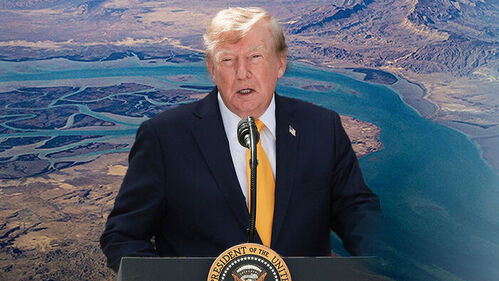
US President Donald Trump has claimed that all mines have been removed or detonated from the international waters of the Strait of Hormuz, declaring that the strategic waterway has been cleared of one of the most serious threats to commercial shipping.
Trump made the claim on Tuesday, August 25, 2026, as the United States continues to confront Iran over control of the crucial maritime passage, through which a significant share of the world's oil and liquefied natural gas traditionally passes.
In a post on his Truth Social platform, Trump said he had been informed that all mines had been cleared or detonated and warned Iran against attempting to lay new explosives in the waterway.
He also said the United States had adopted a “zero tolerance” policy towards any new mine-laying activity, warning that vessels involved would be destroyed. (Reuters)
The declaration could have major implications for international shipping and global energy markets. However, reports indicate that mine-clearing operations and navigational risks remain an evolving issue, meaning Trump's statement does not necessarily mean the Strait of Hormuz is immediately returning to normal commercial traffic.
Trump tells US forces cleared the mines
According to Trump, the US Navy has removed or destroyed mines from international waters in the Strait.
The president also claimed that the US Space Force is monitoring “every square inch” of the strategic waterway, apparently as part of efforts to detect any future attempt to lay mines.
Trump's warning was directed primarily at Iran, which Washington has accused of using mines and other maritime tactics to restrict navigation through the strait.
The US president said Iran had been informed that any ship or boat attempting to place new mines would be “immediately and systematically destroyed.”
The statement represents a significant escalation in Washington's warning to Tehran and underscores the military importance the United States attaches to keeping the waterway open.
Why the Strait of Hormuz matters
The Strait of Hormuz is one of the world's most strategically important maritime chokepoints.
It connects the Persian Gulf with the Gulf of Oman and the wider Arabian Sea. Before the current conflict, approximately 20% of global oil and liquefied natural gas shipments passed through the waterway.
The strait is therefore vital not only to Middle Eastern oil producers but also to major energy-consuming economies in Asia, Europe and elsewhere. Any prolonged disruption can push up energy prices, increase shipping insurance costs and contribute to inflation.
Reuters reported that oil shipments through the strait had fallen to around 5 million barrels per day, compared with more than 20 million barrels per day before the conflict.
That dramatic reduction demonstrates the economic consequences of continued insecurity.
Mine threat has complicated efforts to reopen the waterway
Sea mines are particularly dangerous because they can remain hidden beneath the surface and threaten commercial vessels even after active fighting has decreased.
The possibility of mines has therefore become one of the central obstacles to restoring normal navigation.
Trump's announcement that the mines have been cleared could theoretically encourage shipping companies and energy firms to resume operations.
However, maritime security organizations have continued to warn that risks remain.
The Joint Maritime Information Centre (JMIC) previously warned that mine danger areas remained active and that clearance operations were continuing, highlighting a discrepancy between political statements and the more cautious assessments used by maritime operators. (Seatrade Maritime News)
This means shipping companies are likely to rely on detailed navigational and security assessments rather than Trump's declaration alone before deciding whether to send vessels through the area.
Iran and Oman discuss a temporary shipping corridor
Trump's announcement came at almost the same time that Iran and Oman resumed discussions over managing traffic through the Strait of Hormuz.
The two countries announced plans for a temporary navigational corridor and cooperation on mine-clearing operations.
The initiative is aimed at gradually restoring safe passage while broader discussions continue over the long-term management of the strategic waterway.
The diplomatic effort is significant because Oman has historically played an important role in facilitating communication between Iran and Western countries.
The proposed corridor could provide an alternative mechanism for gradually restoring commercial shipping while reducing the immediate risk of confrontation.
Shipping remains far below normal levels
Despite Trump's assertion that the waterway has been cleared, shipping activity remains severely depressed compared with pre-war levels. Reuters reported on August 20 that only nine commodity vessels passed through the Strait of Hormuz on both the Tuesday and Wednesday of that week, according to Kpler tracking data. That was dramatically below normal traffic levels.
The low traffic highlights an important distinction between physical clearance of mines and restoration of commercial confidence.
Even if mines have been removed, shipping companies must also consider missile attacks, drones, naval confrontations, insurance costs, potential blockades and the possibility that mines could be laid again.
Consequently, reopening the waterway fully could take longer than simply completing a mine-sweeping operation.
US warns against renewed mine-laying
Trump's warning suggests Washington expects the mine threat could return even after current clearance operations.
The president has effectively placed responsibility for any future disruption on Iran, saying vessels involved in laying new mines would be destroyed.
The warning creates a potentially dangerous situation because any attempt to lay mines could trigger direct military action by US forces.
That raises the possibility that the Strait could become the scene of renewed confrontation even if broader hostilities between Washington and Tehran remain relatively contained.
The United States has also increased naval surveillance and maintained a strong military presence in the region.
Global energy markets remain vulnerable
The stakes extend far beyond the Gulf.
Any prolonged restriction on Hormuz traffic could affect crude oil and LNG prices around the world.
Countries in Asia are particularly exposed because major economies such as China, Japan, South Korea and India depend heavily on Middle Eastern energy supplies.
European markets could also feel the consequences indirectly through global energy prices.
Higher oil prices increase transportation and manufacturing costs, while higher gas prices can affect electricity generation and household energy bills.
For developing economies, another major energy-price shock could intensify inflationary pressures and weaken economic growth.
Alternative routes provide only limited relief
Some Gulf oil producers have alternative pipelines that allow part of their exports to bypass the Strait of Hormuz.
Saudi Arabia and the United Arab Emirates, for example, have invested in infrastructure capable of moving some crude directly to ports outside the Persian Gulf.
However, these alternative routes cannot fully replace the enormous volumes normally transported through Hormuz.
This means the strait will remain strategically important even if regional states continue developing alternative export routes.
Recent analysis has suggested that the long-term expansion of alternative routes could gradually reduce Gulf states' dependence on Hormuz, but the waterway remains indispensable in the short term. (The Guardian)
The difference between Trump's claim and maritime reality
One of the most important issues surrounding Trump's announcement is the distinction between a military assessment and commercial shipping clearance. Trump says the mines have been removed or detonated. US officials have also indicated that key inbound and outbound shipping lanes have been cleared. (Jerusalem Post)
However, maritime authorities have continued to issue warnings about residual risks and ongoing clearance operations. For shipping companies, therefore, the question is not simply whether mines have been removed.
They also need assurances that the waterway will remain secure and that vessels will not face renewed attacks.
A potential turning point
Trump's claim could nevertheless represent an important turning point in the crisis. If the main shipping lanes are genuinely clear and security conditions improve, more oil tankers could begin moving through the strait.
That would increase global oil supplies, potentially reduce pressure on energy prices and help ease disruptions to international trade.
Iran and Oman's proposed temporary corridor could reinforce that process by providing a diplomatic framework for managing navigation.
But the situation remains fragile. The two countries are still negotiating the future of the waterway, while Washington continues to exert economic and military pressure on Tehran.
What happens next?
The coming weeks will determine whether Trump's declaration translates into a meaningful reopening of the Strait of Hormuz. Shipping companies are likely to watch mine-clearance operations, naval activity and security warnings closely before increasing traffic.
Meanwhile, Iran and Oman are expected to continue discussions over a temporary corridor and longer-term arrangements for managing navigation.
For Washington, successfully reopening the waterway would represent an important strategic and economic achievement. For Tehran, maintaining influence over Hormuz remains a crucial bargaining tool. The international community therefore faces a delicate situation: a physically cleared shipping lane does not automatically mean a politically secure waterway.
Trump's announcement that all mines have been cleared is potentially significant, but the continued caution among maritime authorities shows that the crisis is far from over.
Until shipping traffic returns to something approaching normal levels, the Strait of Hormuz will remain one of the world's most closely watched geopolitical and economic flashpoints.