Tinubu Rallies Political Support for Governor Oyebanji’s Re-election Bid Ahead of 2026 Ekiti Poll
President Bola Tinubu has reportedly intensified consultations and political engagements aimed at securing support for Ekiti State Governor Biodun Oyebanji’s re-election in the 2026 gubernatorial election, strengthening APC’s position in the South-West.
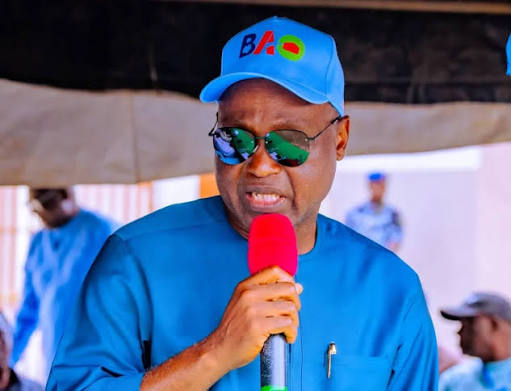
President Bola Ahmed Tinubu has begun strategic political consultations and behind-the-scenes engagements aimed at consolidating support for the re-election bid of Ekiti State Governor, Biodun Abayomi Oyebanji, ahead of the 2026 governorship election in the state.
The move, according to political insiders within the ruling All Progressives Congress (APC), reflects the presidency’s growing interest in stabilizing party control across the South-West region, which remains a key political stronghold for the party.
Oyebanji, who assumed office in October 2022, is expected to seek a second term in 2026, and his administration has consistently emphasized continuity in governance, infrastructure development, and civil service reforms as core pillars of its agenda.
Sources within political circles suggest that Tinubu has been meeting with key APC stakeholders, traditional rulers, and influential party leaders from Ekiti State to build consensus around the governor’s second-term ambition.
Although no formal public endorsement has been issued, the consultations are widely interpreted as a strong signal of presidential backing for Oyebanji’s re-election campaign.
Party leaders say Tinubu’s involvement is aimed at preventing internal divisions within the APC that could weaken the party’s chances in what is expected to be a competitive election cycle.
Ekiti State has historically played a significant role in South-West politics, often serving as a battleground for influence between major political blocs.
The governor’s performance since taking office has been a major talking point among stakeholders, with supporters highlighting achievements in road construction, education reforms, agricultural development, and civil service restructuring.
Oyebanji has also been credited with maintaining relative political stability in the state, avoiding major intra-party crises that have affected other states in the region.
However, opposition voices argue that more needs to be done in areas such as youth employment, industrial development, and rural infrastructure before voters can fully endorse a second term.
Within the APC, political observers note that Tinubu’s support could prove decisive in shaping the party’s internal primaries, where consensus-building often plays a major role in determining candidates.
Analysts say the president’s political influence, particularly within the South-West, remains a powerful factor in determining electoral outcomes, especially in states where party loyalty is strong.
The push for Oyebanji’s re-election is also seen as part of a broader strategy by the APC to maintain dominance in key states ahead of the 2027 general elections.
Political commentators believe that securing Ekiti State is strategically important for the ruling party, not only for regional balance but also for maintaining momentum in national politics.
In recent months, Oyebanji has increased his engagements with community leaders, youth groups, and development stakeholders across the state, reinforcing his administration’s focus on grassroots governance.
His government has also highlighted ongoing projects in road rehabilitation, school modernization, healthcare upgrades, and agricultural empowerment schemes designed to boost food production and rural livelihoods.
Supporters argue that these initiatives demonstrate continuity and steady governance, which they say justify a second term to complete ongoing projects.
Meanwhile, opposition parties in Ekiti have begun preliminary mobilization efforts, although none have officially announced a major challenger for the 2026 election.
Political analysts expect the race to intensify closer to the primaries, especially if the APC moves toward a consensus candidate backed by the presidency.
Tinubu’s reported involvement has sparked varied reactions among political stakeholders, with supporters praising the move as a stabilizing force within the party.
Critics, however, caution that excessive central influence in state-level elections could limit internal democracy and discourage competition within political parties.
Despite these concerns, APC leaders insist that consultations are part of normal political strategy and necessary for maintaining unity and electoral strength.
A senior party official in the South-West, speaking anonymously, described the president’s engagement as “routine political alignment aimed at ensuring continuity and success for the party in Ekiti.”
The official added that Oyebanji’s governance record has made him a strong candidate for continuity, noting that internal party cohesion would be crucial in securing victory.
Traditional rulers in Ekiti State have also reportedly been engaged in discussions aimed at promoting peace, stability, and development-focused leadership ahead of the election cycle.
Community leaders emphasize that governance outcomes, particularly in rural areas, will play a significant role in shaping voter sentiment in 2026.
Observers say the coming months will be critical as political alignments continue to take shape across the state.
For Oyebanji, the challenge will be to maintain broad-based support while addressing emerging socio-economic concerns, including inflationary pressures, infrastructure gaps, and unemployment.
For the APC, the priority remains consolidating its hold on Ekiti State while avoiding internal disputes that could weaken its electoral position.
As the political landscape gradually shifts toward election season, Tinubu’s engagement signals the early groundwork being laid for what is expected to be a closely watched gubernatorial contest in the South-West.
Whether this backing translates into a smooth path for Oyebanji’s re-election will depend on both party unity and the governor’s ability to sustain public confidence in his administration over the coming months.
For now, political attention in Ekiti is firmly focused on the unfolding alignments, with stakeholders preparing for what could be one of the most strategic elections in the region’s recent history. (Vanguard news)