South Korea’s Former Justice Minister Jailed 25 Years Over Failed Martial Law Plot
Former South Korean Justice Minister Park Sung-jae has been sentenced to 25 years in prison for his role in the failed 2024 martial law declaration, marking another major conviction stemming from the political crisis that toppled former President Yoon Suk Yeol.
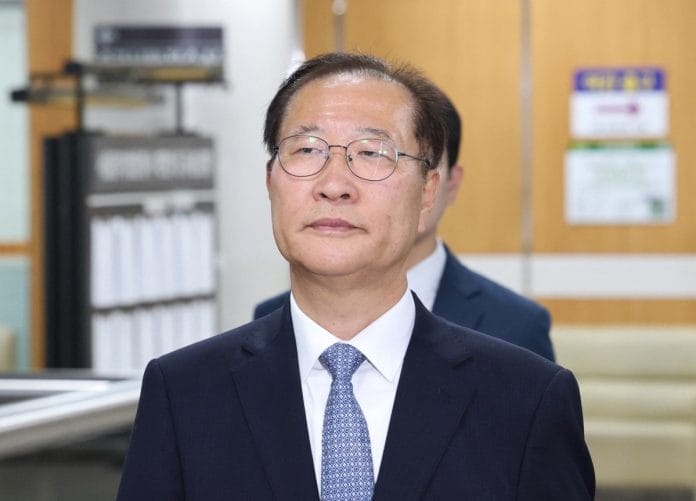
South Korea's sweeping crackdown on those involved in the country's failed martial law declaration intensified on Monday after a Seoul court sentenced former Justice Minister Park Sung-jae to 25 years in prison for his role in what judges described as an attempt to undermine the nation's constitutional order. (Reuters)
The ruling represents one of the harshest punishments handed down since the unprecedented political crisis that erupted in December 2024, when then-President Yoon Suk Yeol briefly imposed martial law in a move critics described as an attempted self-coup.
The Seoul Central District Court found Park guilty of playing a pivotal role in supporting the declaration, including helping coordinate government measures that would have enabled widespread arrests, restrictions on political opponents and other extraordinary emergency actions. Prosecutors argued that his involvement went far beyond routine ministerial duties and instead constituted active participation in an insurrection. (AP News)
According to the court, Park abused the powers of his office by assisting in efforts to give legal cover to an unconstitutional seizure of authority. Judges ruled that his actions threatened South Korea's democratic institutions and justified a severe sentence.
The court also ordered Park's immediate detention, citing concerns that he could interfere with evidence if allowed to remain free while appealing the verdict. (AP News)
Park denied the accusations throughout the trial, insisting that every decision he made fell within the scope of his official responsibilities as justice minister. His legal team argued that he neither planned nor directed the martial law declaration and merely carried out administrative duties required of his office.
The judges rejected that defence, concluding that Park knowingly assisted with the broader plan and understood the constitutional implications of his actions.
The verdict is another dramatic chapter in one of South Korea's most turbulent political scandals in decades.
The crisis began on December 3, 2024, when President Yoon Suk Yeol unexpectedly declared martial law, claiming the country faced threats from so-called "anti-state forces" and alleging election fraud without presenting convincing evidence.
The declaration sent armed soldiers into the National Assembly and other key government institutions. However, lawmakers managed to convene despite military attempts to block access and voted overwhelmingly to overturn the emergency decree.
Within roughly six hours, Yoon rescinded the martial law order, but the political fallout had already become irreversible.
Mass demonstrations erupted across the country as opposition parties accused the president of attempting to dismantle constitutional democracy.
Parliament subsequently impeached Yoon, who was later formally removed from office before prosecutors launched an extensive criminal investigation into the planning and execution of the failed martial law order.
That investigation has since implicated numerous senior officials, military commanders and cabinet members who allegedly helped organize or implement emergency measures.
Yoon himself has already received a life prison sentence after being convicted of masterminding the insurrection, with the court concluding that he deliberately sought to use military force to override democratic institutions and retain power.
Several of his closest allies have also faced lengthy prison terms.
Former Prime Minister Han Duck-soo was earlier sentenced to 23 years after being found guilty of aiding the insurrection, while former Defence Minister Kim Yong Hyun received one of the heaviest punishments among cabinet officials for his involvement in planning the operation.
Legal analysts say Park's conviction reinforces the judiciary's determination to hold every senior official accountable, regardless of rank, for participating in the failed attempt to suspend constitutional government.
Observers note that South Korea's courts have consistently ruled that the martial law declaration amounted to an insurrection rather than a lawful exercise of presidential emergency powers.
The prosecution had originally sought a lengthy prison sentence for Park, arguing that as justice minister he was uniquely positioned to ensure government actions complied with the constitution. Instead, prosecutors said, he allegedly became one of the architects of measures designed to suppress political opposition and legitimize the military takeover.
In delivering Monday's judgment, the court emphasized that public officials entrusted with safeguarding the rule of law bear greater responsibility when constitutional protections are threatened.
Political analysts believe the latest conviction could further strengthen public confidence in South Korea's judicial system, which has moved aggressively against former leaders and senior officials implicated in the crisis.
The succession of high-profile convictions has also sent a powerful message that attempts to subvert democratic institutions will have severe legal consequences.
Although Park is expected to appeal the verdict, legal experts say appellate courts have so far largely upheld the lower courts' findings regarding the unconstitutional nature of the martial law declaration.
For many South Koreans, Monday's sentencing closes another chapter in a crisis that shook one of Asia's most stable democracies.
Yet investigations into remaining officials connected to the failed declaration continue, suggesting that additional prosecutions could still emerge as authorities work to establish accountability for one of the country's most dramatic constitutional crises in modern history.