Somaliland’s Recognition: Israel’s Bold Move, Somalia’s Backlash and the Region’s Future
Israel’s recognition of Somaliland could reshape Somali politics, regional alliances, and citizen security across the Horn of Africa.
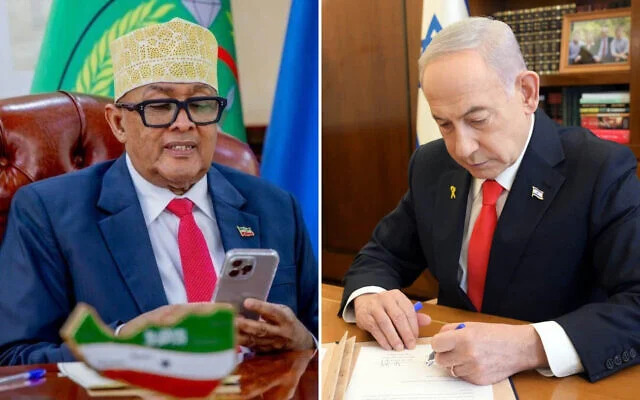
In a dramatic and unprecedented diplomatic development, Israel has become the first country in history to formally recognise the breakaway region of Somaliland as an independent and sovereign state, a move that has instantly reverberated across the Horn of Africa and beyond.
The decision, announced on 26 December 2025, marks a watershed shift in regional geopolitic and poses far-reaching questions about Somalia’s territorial integrity, Israeli foreign policy, and the future security and political rights of citizens in both capitals and local communities. Al Jazeera+1
A Historic Shift: Israel and Somaliland Go Official
Israeli Prime Minister Benjamin Netanyahu signed a mutual recognition agreement with Somaliland President Abdirahman Mohamed Abdullahi “Irro,” establishing full diplomatic ties, including plans to exchange ambassadors and open embassies. Netanyahu described the recognition as being “in the spirit of the Abraham Accords,” and envisaged cooperation in agriculture, technology, health, and security. Anadolu Ajansı
For Somaliland, which declared independence from Somalia in 1991 following the collapse of the Siad Barre regime and has operated as a de-facto state for over three decades with its own currency, police, and institutions, the moment was hailed as historic. Somaliland’s leadership described the recognition as validation of their pursuit of international legitimacy and a new chapter in partnership and development. Somalia Today
Many in the streets of Hargeisa, Somaliland’s capital, celebrated the announcement with Israel’s flag visible in spontaneous gatherings, an unusual sight in a majority-Muslim society, reflecting the gravity of formal recognition after decades of diplomatic isolation. Reddit
Somalia’s Furious Rejection and the Politics of Unity
From Mogadishu, the reaction was immediate and unequivocal. The Federal Government of Somalia denounced Israel’s move as a “deliberate attack” on its sovereignty, asserting unequivocally that Somaliland remains an “integral, inseparable, and inalienable part” of Somali territory.
Somalia’s government stated that the recognition violates both the Somali constitution and international law, warning that no external actor has the right to redraw borders or alter the status of a sovereign state unilaterally. It pledged to oppose the move through legal, diplomatic, and political channels.
Beyond Mogadishu’s objections, a coalition of regional powers and organisations,, including the African Union, Arab League, Gulf Cooperation Council, Egypt, Turkey and Djibouti issued strong condemnations, warning that the Israeli action threatens regional stability, undermines sovereignty principles, and sets a dangerous precedent for secessionist movements.
The African Union reiterated its foundational principle of respecting colonial-era boundaries, stressing that recognition of breakaway regions undermines the continental political order and could embolden other separatist causes across Africa.
Why Israel Took This Step: Strategic Calculations
Israel’s decision to recognize Somali land was not merely symbolic. The tiny self-declared republic occupies a strategic position along the Gulf of Aden, adjacent to key maritime routes that connect the Red Sea and the Suez Canal, a long critical arteries of global trade and naval strategy. The Week
For Tel Aviv, establishing a foothold here aligns with broader geopolitical ambitions, notably increasing its influence in Africa and creating new strategic depth along maritime corridors, territory where rival powers also project military and commercial interests.
The move also extends the broader framework of the Abraham Accords, historic peace agreements initially brokered between Israel, the UAE and others, and now seen as a vehicle for expanding Israel’s diplomatic footprint in the Middle East and the Horn of Africa.
Implications for Somalia’s Politics and National Identity
For the Somali people, Israel’s recognition of Somaliland strikes at the heart of national identity, cohesion and political legitimacy. Since independence, Somalia has wrestled with fragility, civil war, and governance challenges. Somaliland’s unilateral break in 1991 created a long-standing political impasse: stable but unrecognised in the north, contrasted with weak federal governance in the south.
If more states follow Israel’s lead, the international legitimacy of the Somali federal model could erode. Many citizens now fear that Somalia’s sovereignty might be compromised, not only politically but in practical governance and security terms. The Somali government has warned that external recognitions may draw foreign military bases or entangle the country in proxy conflicts, potentially inviting broader instability.
The ramifications go deeper: breakaway recognition may stimulate internal secessionist movements elsewhere, encourage foreign investors to bypass Mogadishu in favour of Hargeisa, and entrench divisions that make national reconciliation more difficult thus affecting citizens’ lives long after the diplomatic headlines fade.
Security Impacts: Citizen Safety and Regional Stability
Somalia’s government officials have expressed concern that the recognition could exacerbate political and security tensions, offering fertile ground for militant groups such as Al-Shabaab and ISIS affiliates to exploit uncertainty and territorial disputes.
This is not speculation: divided governance already complicates coordinated security responses. If Somaliland’s independence is formalised internationally, the federal government may find it even harder to secure borders and synchronise counter-insurgency strategies, leaving civilians in both regions more vulnerable to militant threats.
Furthermore, recognition may attract foreign military interests to Somaliland’s ports and base, raising the spectre of the Horn of Africa becoming a theatre for wider Middle Eastern or global power contests. For citizens, this can translate into heightened insecurity, displacement risks and diminished local control over security forces.
Local populations already face environmental shocks, food insecurity and economic marginalisation; political fragmentation driven by contested sovereignty adds another layer of risk. Communities along contested borders may see spikes in conflict and reduced access to essential services as federal and regional authorities struggle to assert control.
International Law, Precedent and Continental Risks
One of the fiercest criticisms of the Israeli recognition is that it undermines key norms of international law, especially the principle of territorial integrity enshrined in the United Nations Charter and repeatedly emphasised by the African Union.
Somalia’s rejection asserts that no foreign nation can unilaterally alter boundaries or sovereignty status without the consent of the state concerned. This principle, if eroded, could weaken global systems governing state recognition and incite constitutional crises in other multi-ethnic and federal countries.
Regional leaders argue this could encourage movements like Biafra in Nigeria or the Polisario Front in Western Sahara to seek diplomatic endorsements, potentially destabilising entire regions and igniting conflicts far beyond the Horn of Africa. Foreign Affairs Forum
What Somaliland Seeks and the Citizens’ Perspective
Somaliland’s aspiration for formal recognition is neither new nor spontaneous. Its leaders argue that, despite lacking legal recognition, the territory has sustained relative stability, functioning institutions, a currency and security forces absent in much of Somalia for over three decades.
Many Somalilanders view recognition as overdue justice for their peaceful governance, contrasting with Somalia’s years of war and fragmentation. They believe that diplomatic legitimacy will unlock access to international finance, trade arrangements, development aid and investor confidence currently denied by their unrecognised status.
Public sentiment in Hargeisa, as videos and on-the-ground reports show, reflects optimism that recognition will expand economic opportunities and political engagement with the wider world.
Conclusion: A Turning Point with No Easy Answers
Israel’s recognition of Somaliland as an independent state is far more than a headline-it is a geopolitical earthquake with implications for international law, African unity, Horn-of-Africa stability and the lived realities of ordinary people.
For Somalia, it represents a profound challenge to sovereignty and political cohesion. For Somaliland, it offers a long-sought path toward legitimacy and opportunity. For Israel, it signals strategic ambition in a region of global significance. And for citizens across the Horn of Africa, it raises urgent questions about security, governance and economic futures that will play out long after this initial decision.
The coming months will reveal whether this bold diplomatic move will encourage other nations to follow suit or whether strong regional opposition and legal constraints will limit its impact. Either way, the lives of millions in Somalia, Somaliland and the broader region are likely to be shaped by decisions born in faraway capitals but grounded in deep local realities.