Skyline University Secures NUC Approval to Offer Artificial Intelligence Degree, Becomes First in North-West Nigeria
Skyline University Nigeria has secured NUC approval to offer a BSc in Artificial Intelligence, becoming the first university in North-West Nigeria to introduce the degree programme.
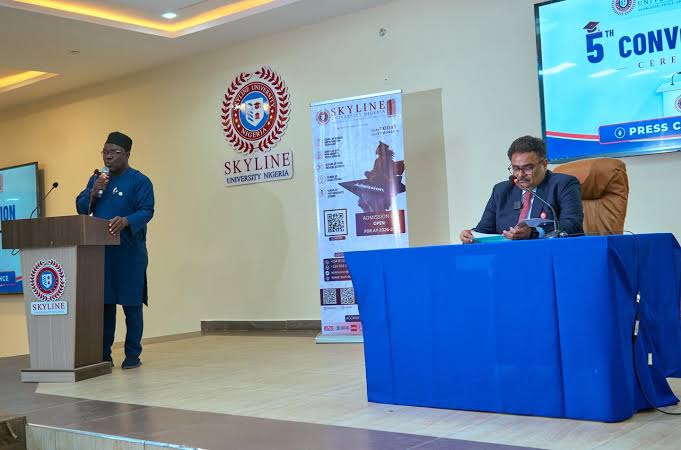
Skyline University Nigeria has secured approval from the National Universities Commission (NUC) to offer a Bachelor of Science degree in Artificial Intelligence (AI), making it the first university in Nigeria’s North-West region to introduce the programme.
The approval marks a significant development for technology-focused higher education in the region, as Nigerian universities increasingly expand their academic offerings to reflect the growing importance of artificial intelligence, data science and other emerging technologies.
The university’s Vice-Chancellor, Professor Ajith Kumar V. V., announced the development on Monday, November 9, during a press briefing in Kano ahead of the institution’s fifth convocation ceremony scheduled for November 14, 2026.
According to the vice-chancellor, the NUC has also approved two additional programmes: BSc Islamic Economics and Finance, and BSc Public Health Science.
The development which said the approval positions Skyline University as the first institution in the North-West to offer an undergraduate degree in Artificial Intelligence.
Three programmes receive regulatory approval
The AI degree is part of a wider expansion of the university’s academic programmes. The newly approved Islamic Economics and Finance course is expected to provide students with opportunities to study financial systems and economic principles, while Public Health Science will strengthen the institution’s health-related academic offerings.
Kumar said the approvals reflected the university’s commitment to expanding its programmes in response to changing educational needs and employment opportunities.
The university also announced that it would confer doctorate degrees for the first time at its forthcoming convocation. A total of 236 graduands are expected to receive academic awards and degrees.
The graduating class comprises 183 bachelor’s degree holders, 41 higher-degree graduates and 12 doctoral graduates from the School of Postgraduate Studies.
The vice-chancellor disclosed that 30 undergraduate graduands earned First Class Honours, while 89 obtained Second Class Upper Division and 64 graduated with Second Class Lower Division.
The university also announced a 50 per cent postgraduate scholarship for graduating students who emerged as the top performers in their respective programmes. The initiative is intended to encourage academic excellence and enable outstanding students to continue their studies at the institution.
HP Gaming Garage to support technology training
Beyond the new degree programmes, Skyline University has unveiled what it described as Africa’s first HP Gaming Garage, a facility designed to expose students to emerging digital technologies and practical innovation.
According to Kumar, the facility will provide opportunities for students to develop skills in game development, artificial intelligence, design thinking and digital innovation.
The initiative is expected to complement the university’s technology-focused academic direction by exposing students to practical experiences beyond conventional classroom teaching.
The facility also reflects the growing importance of industry-linked learning in preparing graduates for a labour market increasingly shaped by automation, software development and digital services.
Kumar said the university was determined to strengthen its international partnerships and improve the connection between academic learning and professional practice.
He disclosed that Skyline had signed memoranda of understanding with IMS Unison University and Sikkim Sardar Patel University in India, as well as the RV Institute of Management.
The university also plans to have industry experts deliver 10 per cent of its curriculum, giving students exposure to professional practices and helping them understand the demands of the workplace.
AI education gains importance in Nigeria
Skyline University's approval comes amid growing efforts to integrate artificial intelligence and other emerging technologies into Nigeria's higher education system.
The National Universities Commission has repeatedly emphasised the need for universities to move beyond theoretical instruction and equip students with practical skills in science, technology, engineering and mathematics.
In August 2026, the commission reported progress on a proposed National STEM Transformation Strategy intended to reposition universities as centres of innovation, research and industrial development. The strategy identifies artificial intelligence, robotics, biotechnology, advanced manufacturing and renewable energy as important areas for Nigeria's future economic growth.
The NUC's position is that universities must produce graduates capable of developing practical solutions to challenges in healthcare, technology, manufacturing and other sectors.
Nigeria's National Artificial Intelligence Strategy also identifies talent development as a major requirement for building a sustainable AI ecosystem. It recommends curriculum reforms, specialised training, teacher development and stronger research capacity to prepare Nigerians for opportunities in the emerging technology sector.
The strategy further proposes the development of AI research and development funding to support innovation and attract skilled professionals.
Universities expand AI degree offerings
Skyline is not alone in responding to the growing demand for formal AI education.
Other Nigerian institutions have also secured regulatory approval to introduce artificial intelligence programmes, reflecting an expanding national interest in technology-driven academic courses.
In September 2026, the NUC approved 30 new programmes for the Federal University Dutse, including BSc Artificial Intelligence, Data Science and Information Systems. The approvals also covered several health, science and postgraduate programmes, with the university expected to commence the approved courses in the 2026/2027 academic session.
Similarly, the Enugu State University of Science and Technology secured approval in July 2026 to introduce five full-time undergraduate programmes, including Artificial Intelligence, Cyber Security, Data Science and Software Engineering.
These developments suggest that AI education is becoming an increasingly important component of Nigeria's university curriculum.
Infrastructure and skilled lecturers remain essential
Although the introduction of AI degree programmes represents progress, the quality of their implementation will determine how much value students ultimately receive.
Artificial intelligence is a specialised field requiring more than conventional computer laboratories. Effective training depends on access to suitable computing infrastructure, reliable internet connectivity, relevant software, research facilities and lecturers with appropriate expertise.
Students also need practical exposure to programming, mathematics, statistics, machine learning, data analysis and the ethical implications of automated systems.
Universities must therefore ensure that their academic programmes combine theoretical knowledge with practical projects, research opportunities and industry collaboration.
There are also concerns about the responsible use of AI in education, particularly regarding academic integrity, data privacy and the reliability of AI-generated information. The Federal Government has urged universities to adopt emerging technologies while strengthening safeguards around ethics, accountability and institutional governance.
For Skyline University, the new approval presents an opportunity to contribute to Nigeria's growing pool of technology professionals and strengthen the North-West's participation in the digital economy.
The university's technology initiatives, international partnerships and proposed industry-led curriculum delivery could support that ambition if backed by sustained investment and effective implementation.
As the demand for AI expertise expands across industries, the availability of accredited degree programmes within Nigeria could also reduce the pressure on students seeking specialised technology education abroad.
The challenge now is to translate regulatory approval into high-quality teaching, meaningful research and graduates equipped to develop solutions for Nigeria and the wider world.