Shettima Returns to Nigeria After Leading Delegation to 81st UN General Assembly
Vice President Kashim Shettima has returned to Nigeria after representing President Bola Tinubu and leading the Nigerian delegation to the 81st UN General Assembly in New York.
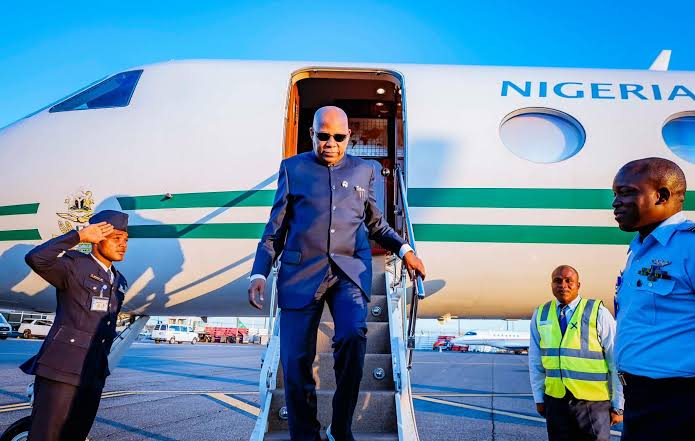
Vice President Kashim Shettima has returned to Nigeria after leading the country’s delegation to the 81st Session of the United Nations General Assembly (UNGA 81) in New York, where he represented President Bola Ahmed Tinubu and presented Nigeria’s position on several major international issues.
Shettima departed Abuja on September 20, 2026, after President Tinubu mandated him to represent the Federal Government at the annual gathering of world leaders. He returned to Nigeria on Monday, September 28, following the conclusion of his official engagements. (Premium Times)
The 81st UN General Assembly’s high-level week was held under the theme “Restoring trust, managing transformation: A United Nations that delivers for all.” Nigeria used the gathering to advance its positions on global governance, development financing, climate action, economic cooperation, education and Africa’s representation in international institutions.
Shettima Delivers Nigeria’s National Statement
One of the Vice President’s principal responsibilities during the visit was delivering Nigeria’s national statement at the General Debate on behalf of President Tinubu.
In the address, Nigeria renewed its call for reform of the United Nations Security Council, including permanent African representation. The Federal Government argued that the structure of the global body needs to better reflect contemporary geopolitical realities and provide developing countries with a stronger voice in international decision-making. (Channels Television)
Nigeria also advocated fairer global financing arrangements, stronger climate support for developing countries and deeper multilateral cooperation.
The issues are significant for Nigeria and other developing economies, particularly as governments across Africa continue to seek greater access to development finance and international support for climate-related challenges.
Focus on Africa’s Mineral Resources
Shettima also participated in the Third High-Level Roundtable of the Africa Minerals Strategy Group, where the issue of Africa’s vast mineral resources featured prominently.
Nigeria's position, as conveyed during the meeting, was that African countries should move beyond exporting raw minerals and focus increasingly on processing, manufacturing and value addition within the continent.
The approach is aimed at enabling African economies to capture more value from their natural resources, develop industries and create employment rather than depending primarily on the export of unprocessed commodities.
The discussion formed part of Nigeria’s broader economic diplomacy at the United Nations, where the government sought to highlight opportunities for investment, industrial development and stronger international partnerships.
Education Financing Takes Centre Stage
Education was another major issue during Shettima’s UNGA engagements.
At a high-level education financing event co-hosted by Nigeria and Italy, the Vice President reaffirmed the Federal Government’s position that education is an important investment in productivity, human capital and long-term national development.
Shettima also expressed Nigeria’s support for the Global Partnership for Education’s $5 billion financing campaign, which seeks to mobilise resources for education systems in developing countries. (Premium Times)
Nigeria’s participation in the initiative comes as the country continues to emphasise education, skills development and human capital as components of its development strategy.
Engagement with Nigerians in the Diaspora
During his stay in New York, Shettima also met with Nigerians living abroad.
The Vice President highlighted the potential contribution of the Nigerian Diaspora through investment, expertise, professional networks and partnerships.
Diaspora engagement has become an important element of Nigeria’s international outreach, particularly given the size of the Nigerian community abroad and its links to businesses, institutions and professional networks in different parts of the world.
The meeting provided an opportunity for the government to communicate its development priorities while encouraging Nigerians abroad to contribute to national development.
Meetings with UN and ECOWAS Officials
Shettima’s programme also included meetings with senior representatives of international and regional organisations.
He met with UN Deputy Secretary-General Amina J. Mohammed, while another engagement involved the new leadership of the Economic Community of West African States (ECOWAS) Commission.
The discussions covered issues including regional integration, development financing, economic cooperation, technology, peace and security and Nigeria’s wider role in regional affairs.
These engagements formed part of the Federal Government’s effort to use the UNGA platform for bilateral and multilateral diplomacy beyond the formal General Debate.
High-Level Nigerian Delegation
Shettima led a high-level Nigerian delegation that included governors, ministers and other senior government officials.
Among those listed as members of the delegation were Rivers State Governor Siminalayi Fubara and Zamfara State Governor Dauda Lawal, alongside members of the Federal Executive Council and other senior officials.
Before his departure, the Vice President had also received briefings from Foreign Affairs Minister Bianca Odumegwu-Ojukwu and Nigeria’s Permanent Representative to the United Nations, Ambassador Jimoh Ibrahim, on the country's priorities and planned engagements at UNGA 81.
Return to Nigeria
Shettima’s return on September 28 marked the conclusion of his six-day official trip to New York.
According to the Presidency, his engagements were intended to advance Nigeria’s national interests, strengthen multilateral cooperation and deepen strategic partnerships with governments, international organisations and development institutions.
The Vice President’s return also brings Nigeria’s UNGA participation into its post-event phase, with attention likely to shift toward how the diplomatic engagements and discussions translate into concrete partnerships, investment opportunities and international cooperation.
For Nigeria, the 81st UN General Assembly provided a platform to restate its position on reform of global institutions while placing development financing, mineral resources, education, climate action, regional integration and economic cooperation among the issues at the centre of its international engagement.