Sacked Ukrainian Defence Minister Calls for Presidential Election Amid Wartime Political Crisis
Former Ukrainian Defence Minister Mykhailo Fedorov has called for presidential elections despite martial law, challenging President Volodymyr Zelenskyy amid growing concerns over corruption and governance.
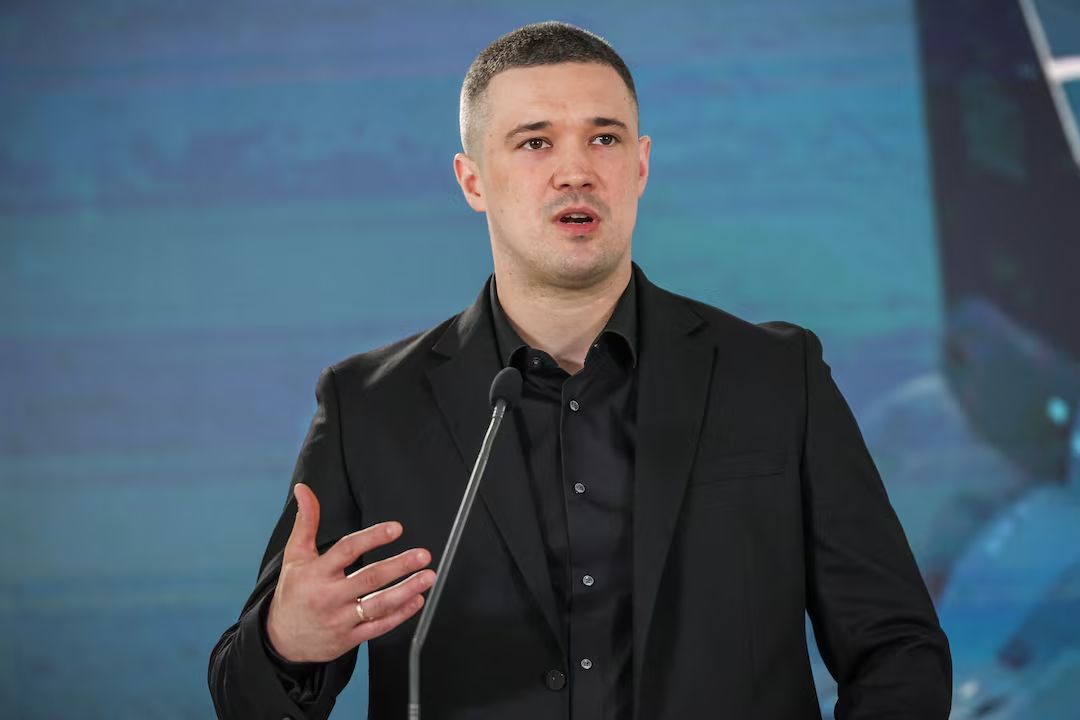
Ukraine's former Defence Minister Mykhailo Fedorov has called for presidential elections to be held despite the country's ongoing war with Russia, delivering one of the strongest political challenges to President Volodymyr Zelenskyy since Russia launched its full-scale invasion in 2022.
Fedorov, 35, made the call in a video address published on Tuesday, August 18, arguing that Ukraine needs to find a legal, secure, and practical mechanism to restore its democratic electoral process even as the war continues.
His intervention is politically significant because Ukraine is currently under martial law, which prevents national elections from being held. The country has not held a presidential election since Zelenskyy's victory in 2019, while parliamentary elections have also been suspended because of the war. (Al Jazeera)
Fedorov's statement comes only weeks after his dismissal as defence minister and hours after Zelenskyy nominated a successor, effectively ending speculation that he could return to the government.
Fedorov demands elections during wartime
In his video message, Fedorov argued that Ukraine's democratic process should not be indefinitely suspended because of the war.
He said that democracy should not be held hostage by Russia and called for the creation of a “legal, safe and realistic mechanism” that would allow Ukrainians to renew the country's democratic process despite the prolonged conflict. (Reuters)
The former minister acknowledged that conducting elections during wartime would be extremely complicated.
The Russian invasion has displaced millions of Ukrainians, while hundreds of thousands of soldiers are serving on the battlefield. Other citizens live close to areas affected by fighting or in territories occupied by Russia.
Fedorov nevertheless argued that the difficulties should not make elections impossible.
His comments represent the first public demand for wartime elections from a major Ukrainian political figure since Russia's full-scale invasion, making the statement particularly significant.
Why Ukraine has no presidential election
Ukraine's presidential election was originally expected to take place in 2024.
However, the country's constitution and election laws prohibit national elections while martial law is in force.
Martial law was introduced following Russia's full-scale invasion in February 2022 and has been repeatedly extended.
As a result, Zelenskyy's five-year presidential term, which was due to expire in May 2024, has continued while martial law remains in place.
Ukrainian officials have argued that holding a national election during an active war would be logistically difficult and potentially dangerous.
Among the biggest challenges are providing voting opportunities for military personnel, protecting polling stations from Russian attacks, enabling displaced Ukrainians to vote and ensuring that citizens living near the front line can participate. (CBS News)
Fedorov's dismissal adds political significance
Fedorov's call for elections carries additional weight because of his recent relationship with Zelenskyy's administration.
The former minister had been a close political ally of the president and was appointed defence minister in January 2026.
His tenure, however, lasted only about six months before Zelenskyy dismissed him in July.
His removal followed growing tensions involving military leadership, particularly his relationship with Ukraine's Commander-in-Chief, Oleksandr Syrskyi.
Fedorov subsequently confirmed that disagreements existed between the two men. Ukrainian media reported that the dispute involved differing views over military management and reforms. (Интерфакс-Украина)
His dismissal triggered protests in Kyiv, with demonstrators demanding his reinstatement and criticising the decision to remove him.
Although Fedorov did not explicitly announce plans to run for president, his growing public profile has prompted speculation about his political ambitions.
Fedorov accuses government of governance crisis
The former defence minister's criticism went beyond the question of elections.
In his address, Fedorov described Ukraine as facing what he called a systemic crisis of governance.
He also criticised corruption and argued that problems within state institutions were undermining the country's ability to fight Russia effectively.
His comments come at a particularly sensitive time for Zelenskyy's administration.
Ukraine has faced repeated corruption controversies during the war, despite efforts by the government to demonstrate that it is strengthening transparency and accountability.
For Ukraine's Western allies, corruption is a particularly important issue because the country relies heavily on European and American financial and military assistance.
Fedorov's argument that corruption can weaken the war effort therefore carries implications beyond domestic politics.
Zelenskyy names a new defence minister
Fedorov's intervention came on the same day that Zelenskyy moved to formalise his replacement.
The president nominated Yevhenii Khmara as the country's new defence minister, effectively closing the door on Fedorov's possible return to the ministry. (euronews)
The timing has fuelled speculation that Fedorov's election call could mark the beginning of a more independent political role.
However, Fedorov has not formally announced a presidential candidacy.
His current position is framed around restoring democratic institutions rather than declaring himself a candidate.
Elections during war would be extremely difficult
Even if political leaders agreed that elections should take place, organising a nationwide vote during an active war would be an enormous logistical challenge.
Ukraine has millions of citizens who have been displaced internally or have fled abroad since 2022.
Ensuring that these people can vote securely and fairly would require significant preparation.
Military personnel would also need mechanisms to vote without compromising operational security.
There are additional concerns about cyberattacks, Russian disinformation, missile strikes and the security of polling stations.
Ukraine would also need to determine how elections could be conducted in territories occupied by Russia, where Ukrainian authorities currently have little or no administrative control.
These difficulties are among the reasons officials have continued to argue that elections should wait until conditions are sufficiently secure.
Growing pressure on Zelenskyy
Fedorov's intervention nevertheless represents a new political challenge for Zelenskyy.
Since the beginning of the full-scale war, Ukraine's political system has been dominated by the urgent demands of national defence.
The suspension of elections has been widely justified on security grounds, but the longer the war continues, the more difficult the question of democratic renewal becomes.
Fedorov's remarks bring that debate into the mainstream of Ukrainian politics.
His criticism is particularly notable because he was previously part of Zelenskyy's political circle.
Rather than coming from a longstanding opposition figure, the demand comes from someone who served within the president's government only months ago.
Fedorov's political future
Fedorov has not said that he intends to contest the presidency.
However, his popularity and his profile as a technology-focused politician have generated speculation about his future.
He previously played a major role in Ukraine's digital transformation and later focused heavily on military technology and drone warfare during his time as defence minister.
His supporters portray him as a reformist capable of challenging entrenched interests within government.
His critics, meanwhile, could interpret the call for elections as an attempt to capitalise on dissatisfaction with the Zelenskyy administration.
For now, there is no indication that a presidential election will immediately take place.
Wider corruption concerns
The political controversy comes as Ukraine's anti-corruption authorities have launched investigations involving senior officials and figures connected to Zelenskyy's administration.
On August 19, Ukrainian anti-corruption agencies announced a high-profile investigation involving alleged money laundering and senior political figures. The developments have increased pressure on Zelenskyy's government and added context to Fedorov's criticism of corruption. (AP News)
Zelenskyy has faced growing pressure to demonstrate that wartime governance remains accountable and transparent.
The president's supporters argue that extraordinary wartime conditions require political stability, while critics increasingly question how long normal democratic mechanisms can remain suspended.
A new political fault line
Fedorov's demand has opened a potentially significant new fault line in Ukrainian politics.
The immediate issue is whether elections can legally and safely be organised while the war continues.
But the broader debate concerns how Ukraine balances national security, democratic accountability and political legitimacy during an unprecedented conflict.
For Zelenskyy, an election could present both opportunities and risks. It could renew his democratic mandate, but it could also expose his government to a highly competitive political contest during wartime.
For Fedorov, calling for elections positions him as an advocate of democratic renewal while avoiding an immediate declaration of political ambition.
What happens next?
The Ukrainian government has not announced plans to lift martial law or organise a presidential election.
For the moment, elections remain prohibited under the existing wartime framework.
Fedorov's intervention, however, ensures that the issue will receive significantly greater attention.
As the war continues into its fifth year, questions over political legitimacy are likely to become increasingly difficult for Kyiv to avoid.
The former defence minister's call is therefore more than a demand for a vote. It is a challenge over how Ukraine should govern itself while fighting for its survival.
Whether Fedorov ultimately seeks political office remains uncertain. What is clear is that his call for presidential elections has introduced a powerful new dimension to Ukraine's wartime political debate and created the most direct challenge to Zelenskyy's leadership from a former senior government ally since the full-scale invasion began.