Probe Begins into Why Amazon Cargo Plane Overran Miami Runway, Killing Five
US investigators have begun probing why an Amazon cargo plane overran the runway at Miami International Airport, killing five people and injuring five others.
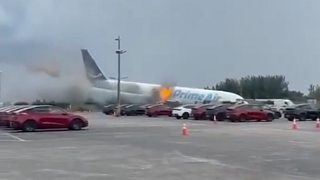
Federal investigators have begun examining the circumstances surrounding the deadly crash of an Amazon cargo aircraft that overran a runway at Miami International Airport, killing at least five people and injuring five others.
The Boeing 767-300 freighter, operated by North Carolina-based 21 Air on behalf of Amazon Prime Air, crashed shortly after landing at Miami International Airport on Sunday, September 6, 2026. The aircraft had arrived from San Juan, Puerto Rico, and left the runway before striking several vehicles and bursting into flames. (Reuters)
The National Transportation Safety Board (NTSB) has taken the lead in investigating the accident, with investigators expected to examine the aircraft, runway, weather conditions, flight data, crew actions and maintenance history as they seek to determine what caused the Boeing 767 to run beyond the available runway.
Five People Killed in Fiery Miami Airport Crash
The cargo aircraft came down at approximately 2 p.m. local time and overran the airport's diagonal runway. After leaving the paved surface, it struck multiple vehicles on the ground before coming to rest and catching fire.
At least five people were killed, while five others were injured. Three of the injured were reported to be in critical condition. The aircraft's two pilots were among those trapped inside the wreckage and were subsequently rescued.
The crash triggered a major emergency response involving more than 60 rescue units and approximately 200 emergency personnel. Firefighters battled the aircraft fire while rescue crews searched for the wreckage and nearby vehicles for survivors.
A fuel leak also complicated the emergency operation, according to preliminary reports.
The airport temporarily halted flight operations following the crash, although normal operations resumed later in the day amid significant delays and cancellations. (Reuters)
NTSB Investigates Why Plane Failed to Stop
The central question for investigators is why the Boeing 767 was unable to stop within the runway's available distance after landing.
Investigators are expected to examine several possible factors, including where the aircraft touched down, its landing speed, braking performance, weather conditions, runway surface conditions and the aircraft's mechanical systems.
Preliminary observations reported by investigators indicate that the aircraft may have landed farther down the runway than intended. Experts assisting the investigation have also raised questions about whether the aircraft was travelling too fast when it touched down.
However, investigators have not yet established that any one of these factors caused the crash.
The NTSB will likely reconstruct the aircraft's final approach using flight-data and cockpit recordings, which can help investigators determine the aircraft's speed, altitude, descent profile, braking actions and crew decisions during the critical final moments of the flight.
Weather Conditions Under Investigation
Weather could also become an important part of the investigation.
Reports indicate that thunderstorms and strong winds were present around Miami at the time of the accident. Investigators will examine wind direction and speed, visibility, precipitation and the condition of the runway when the aircraft landed.
A tailwind can be particularly important during a landing because it increases an aircraft's groundspeed and can reduce the amount of runway available for stopping.
The investigation will therefore determine whether weather conditions affected the aircraft's approach, touchdown point or braking capability. (The Guardian)
At this stage, however, there is no official conclusion that weather caused the crash.
Age and History of Boeing 767 Under Review
The aircraft involved was a 32-year-old Boeing 767 that had originally been built for passenger operations before being converted into a freighter in 2015.
Its age and maintenance history are likely to form part of the investigation, although an aircraft's age alone does not establish that it was unsafe.
Investigators will examine maintenance records, inspection histories and the condition of critical systems, including the landing gear, brakes, thrust reversers and other components associated with stopping the aircraft.
The NTSB will also look at whether the aircraft had any mechanical problems before or during the landing.
Amazon and 21 Air have both indicated that they will cooperate fully with the investigation.
Questions Over Miami Runway Safety
Another issue attracting attention is the physical environment beyond the runway.
The Boeing 767 continued beyond the runway and crossed into an area containing roads and vehicles before coming to rest. Investigators will examine whether additional safety measures could have reduced the consequences of the runway overrun.
Miami International Airport does not have the type of engineered arresting bed used at some airports to stop aircraft that run beyond the runway.
Such systems, known as Engineered Materials Arresting Systems (EMAS), use specially designed materials that collapse beneath an aircraft's wheels and slow the aircraft during a runway overrun.
The absence of such a system does not mean the airport violated safety requirements, but investigators and aviation safety experts may consider whether runway-end protection could have influenced the severity of the accident.
Cargo Aviation Under Fresh Scrutiny
The Miami crash is likely to generate broader scrutiny of cargo aviation, particularly because the aircraft was operating for Amazon Prime Air.
Cargo airlines have expanded significantly alongside the growth of e-commerce, making large freighter aircraft increasingly important to global supply chains.
The accident is also notable because it involves a Boeing 767 freighter, one of the most widely used aircraft types for medium- and long-haul cargo operations.
Investigators will therefore be under pressure to establish whether the accident resulted from circumstances specific to this flight or whether it points to a wider safety issue affecting cargo operations.
Investigation Could Take Months
The NTSB's initial work will focus on securing evidence and reconstructing what happened during the final stages of the flight.
Investigators will typically examine the aircraft wreckage, runway markings and surface, weather data, air-traffic-control communications, flight-data recordings, cockpit voice recordings and maintenance documentation.
They will also interview witnesses, airport personnel and other individuals who may have information about the aircraft's arrival and crash.
The agency's investigation is expected to take considerably longer than the initial field examination. A preliminary report may provide additional facts as investigators progress, but determining the probable cause of a major aviation accident can take months or longer.
For now, officials have not attributed blame to the pilots, airline, aircraft manufacturer, airport or weather.
A Tragedy That Raises Important Safety Questions
The Miami cargo-plane crash has once again highlighted the dangers associated with runway overruns, particularly when airports are surrounded by roads, buildings and other populated areas.
The immediate priority remains determining why the aircraft could not stop safely after landing and whether any warning signs could have prevented the tragedy.
As the NTSB begins its investigation, aviation authorities, Amazon, 21 Air and Boeing are expected to cooperate with investigators.
The final findings could have implications beyond this accident. If investigators identify problems involving aircraft systems, crew procedures, runway conditions, weather assessment or airport infrastructure, their recommendations could lead to changes designed to prevent similar accidents.
For the families of those killed and injured, however, the investigation has an even more immediate purpose: providing answers about what happened during the final moments of the flight.
Until the NTSB completes its work, the cause of the Miami runway overrun remains undetermined.