Polish Unity on Display as Thousands Join Silent March for Kraków Shooting Victims
Thousands of Poles have joined a silent march in Kraków to mourn six victims of a mass shooting, as political rivals President Karol Nawrocki and Prime Minister Donald Tusk set aside differences to demonstrate national unity.
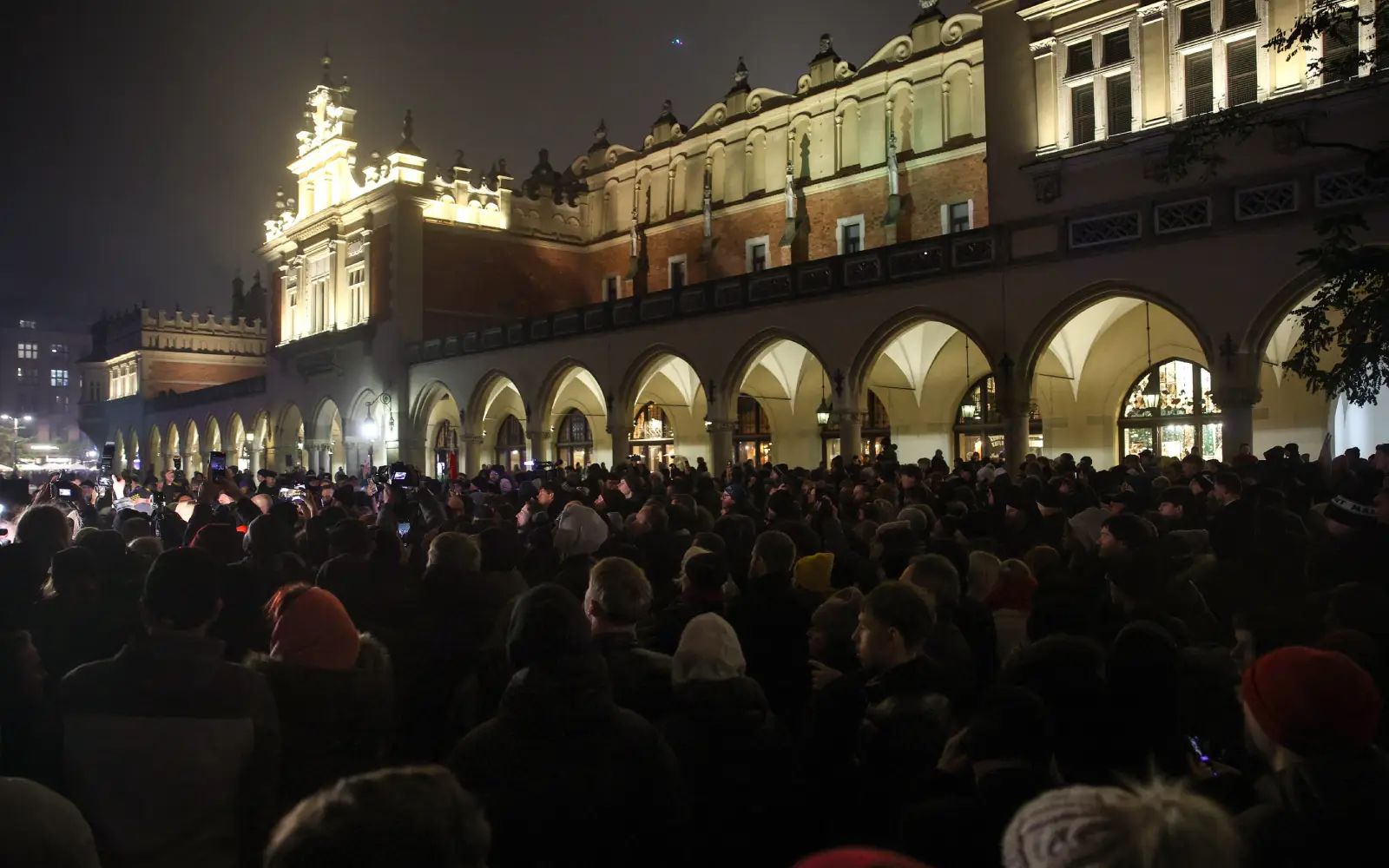
Poland has witnessed an extraordinary display of national solidarity as thousands of people joined a silent march through the historic city of Kraków to honour six people killed in a shocking mass shooting that has shaken the country.
The Monday evening procession brought together citizens from different backgrounds, religious leaders and political representatives, including President Karol Nawrocki and Prime Minister Donald Tusk, whose political differences have frequently placed them on opposite sides of Poland's increasingly polarised political landscape.
The two leaders walked alongside Kraków Mayor Łukasz Gibała, setting aside their political rivalry to lead mourners in remembering the victims of Saturday's deadly attack.
Participants gathered at the city's historic Main Market Square, where the shooting occurred, carrying flowers and candles to honour those who lost their lives.
The march retraced parts of the route taken by the suspected gunman, stopping at locations where victims were killed as mourners observed moments of silence and placed candles at temporary memorials.
The gathering provided a powerful demonstration of national unity at a time when Poland is struggling to comprehend one of the deadliest shooting incidents in its modern history.
Nawrocki and Tusk Set Aside Political Differences
Perhaps the most striking aspect of the memorial was the appearance of Nawrocki and Tusk together.
The nationalist president and centrist prime minister have maintained a difficult political relationship, with disagreements over government policies, constitutional issues and the direction of the country frequently dominating public debate.
Their joint participation in the procession, however, sent a message that national tragedies can transcend political disagreements.
Deputy Prime Minister Władysław Kosiniak-Kamysz described the gathering as a hopeful demonstration of Poland's ability to cooperate despite political differences.
He said the country had shown that people with opposing views could still find common ground, engage in dialogue and support one another during difficult moments.
Tusk also acknowledged the significance of the gathering in a social media post, writing that thousands of Poles had assembled in Kraków to pay tribute to the victims of the November 7 attack.
The participation of the country's two highest political leaders was particularly important given the growing disagreements over the circumstances surrounding the shooting and the possible motives of the attacker.
Silent March Ends With Emotional Musical Tribute
The procession began at approximately 8 p.m. local time, with participants gathering near the city's historic administrative buildings before moving towards the Main Market Square.
Church bells rang as the march began, followed by the traditional bugle call from St. Mary's Basilica, one of Kraków's most recognisable landmarks.
Mourners stopped at locations where the victims had been shot, lighting candles and placing flowers in remembrance.
The emotional climax came near the Town Hall Tower, where a trumpeter performed a section of Simon and Garfunkel's famous song, The Sound of Silence.
The performance carried particular significance because the song had also featured at memorial events following the 2019 assassination of Gdańsk Mayor Paweł Adamowicz.
Cardinal Grzegorz Ryś, the Catholic Archbishop of Kraków, subsequently led participants in prayers for the dead, including the Lord's Prayer and a traditional prayer for eternal rest.
The gathering concluded with messages of solidarity and appreciation for those who had joined the memorial.
According to Kraków's official municipal website, the procession was organised to allow residents and visitors to honour the victims and demonstrate support for their families.
Six People Killed in Historic Square Shooting
The tragedy occurred on Saturday, November 7, when a 24-year-old Polish man identified by prosecutors as Michał Oksiński allegedly drove into Kraków's Main Market Square and opened fire on unsuspecting pedestrians.
The attack left six people dead and 15 injured, including two police officers who confronted the suspected gunman.
The victims included four Polish citizens, a 32-year-old British man and a 51-year-old Austrian woman.
The historic square, located in a UNESCO World Heritage-listed area and among Poland's most popular tourist destinations, became the scene of panic as residents and visitors fled for safety.
Police officers intervened and shot the suspected attacker before taking him into custody. He was critically injured and subsequently died in hospital on Monday.
The shooting has deeply unsettled a country that has traditionally regarded itself as relatively safe compared with several other European nations.
Authorities have also expressed concern about the potential for further violence, particularly following threatening and alarming messages posted online after the incident.
Suspect's Family Also Found Dead
Investigations into the Kraków shooting have revealed an even more disturbing dimension to the tragedy.
Police discovered the bodies of the suspect's father, mother and 21-year-old sister at the family's residence in Ostrowiec Świętokrzyski, approximately 200 kilometres from Kraków.
Preliminary findings indicate that Oksiński may have killed his family members before travelling to Kraków and carrying out the shooting.
Prosecutors said the three victims had suffered gunshot wounds, while firearms and substantial quantities of ammunition were recovered from the property.
Investigators also recovered four firearms and several hundred rounds of ammunition from the suspect's vehicle and belongings.
Authorities are continuing to establish the sequence of events and determine whether the attacker acted alone or received encouragement or assistance from other individuals.
The investigation has continued despite the suspect's death, with prosecutors examining electronic devices, personal belongings and other evidence that could provide insight into his actions.
Dispute Over Possible Far-Right Motivation
The possible motivation behind the attack has become a subject of political controversy in Poland.
Immediately after the shooting, Interior Minister Marcin Kierwiński suggested that initial information pointed towards the suspect having radical views and being fascinated by far-right ideology.
However, the statement attracted criticism from opposition politicians, particularly members of the nationalist Law and Justice party (PiS).
Party leader Jarosław Kaczyński rejected the suggestion of a far-right connection, describing it as an attempt to mislead the public.
The National Prosecutor's Office subsequently urged caution, explaining that investigators had not established the motive behind the killings.
Spokesperson Przemysław Nowak disclosed that a yellow Gadsden flag bearing a coiled snake and the words "Don't Tread on Me" had been found in the suspect's bedroom.
However, he stressed that the flag has different historical and political interpretations and is not necessarily associated with extremist ideology.
Justice Minister Waldemar Żurek also confirmed that investigators would continue examining whether the suspect acted independently or had links to any organised group.
The disagreement has highlighted the political sensitivity surrounding the investigation, with authorities warning against drawing conclusions before the evidence is fully examined.
Police Detain Individuals Over Online Threats
Polish authorities have also increased security following the attack, particularly amid concerns about possible copycat incidents.
The Central Bureau for Combating Cybercrime detained several individuals accused of publishing threatening or alarming material online after the shooting.
Reuters reported that six people, including five Polish citizens and one Ukrainian, were detained over their online posts. The individuals were between 15 and 36 years old.
Police have warned that inflammatory online content could encourage further violence and said security agencies were monitoring potential threats.
The government is also considering a review of gun-licensing regulations following revelations that both the suspect and his father held firearm permits.
The review is expected to examine whether existing procedures provide sufficient safeguards against individuals who may pose a danger to the public.
Poland Declares National Mourning
President Nawrocki declared a period of national mourning on November 8 and 9, while Kraków extended its local mourning period until November 11.
The tragedy has attracted international condolences, including a message from Pope Leo XIV expressing sadness over the deaths and injuries.
The shooting has also renewed discussions about public safety, firearm ownership, online radicalisation and the responsibility of authorities to identify potential threats before they escalate into violence.
For many residents, the silent march represented an opportunity to grieve collectively and demonstrate that violence would not destroy the country's sense of community.
A Powerful Message Beyond Politics
The Kraków procession has become a defining moment for Poland, demonstrating how a national tragedy can temporarily bridge deep political divisions.
The sight of Nawrocki and Tusk walking together alongside thousands of ordinary citizens offered a rare reminder that national solidarity can rise above political competition.
Although disagreements over the suspect's motives and the government's response remain unresolved, the memorial allowed attention to return to the six people whose lives were lost and the families left behind.
As investigations continue and authorities consider tighter security measures, Poland faces the difficult task of understanding how the tragedy happened and preventing a recurrence.
For the thousands who marched silently through Kraków, the message was clear: political differences may divide the country, but in moments of grief, humanity and solidarity must come first.