Police Arrests 12 at London’s Al‑Quds Day Rally
At least 12 people were arrested at London’s Al‑Quds Day rally amid a government ban and heavy policing. Here’s what the demonstration was about, why it was controversial, and what it reveals about tensions surrounding the current Iran war.
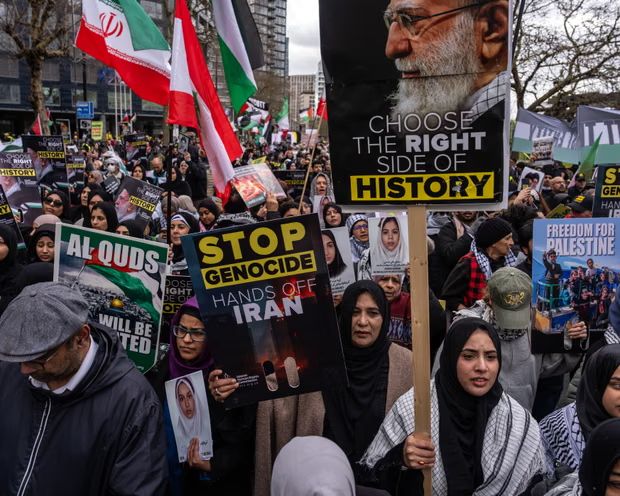
On March 15, 2026, London witnessed a tense and heavily policed Al‑Quds Day rally, with at least 12 arrests reported during the event and associated counter‑protests. The demonstration, which traditionally expresses solidarity with Palestinians, attracted controversy in the United Kingdom this year due to its broader geopolitical resonance with the ongoing war involving Iran, Israel, and the United States. (The Guardian)
Here’s a detailed look at what unfolded, what Al‑Quds Day signifies, and the wider implications of the protests, considering the Iran war and rising global tensions.
What Happened at the Al‑Quds Day Rally in London?
Authorities in London had banned the traditional Al‑Quds march this year, citing serious public order risks due to heightened tensions around the Middle East conflict. (Al Jazeera)
Instead of a march, police allowed a static demonstration at Albert Embankment, on the south bank of the River Thames, near central London. Around 1,000 police officers were deployed to manage protesters and counter‑protesters, with barriers and river buffers used to separate groups.
Despite the restrictions, clashes of rhetoric and political expression led to at least 12 arrests. Charges reportedly included: support for a proscribed organization, affray, abusive or threatening behavior, and public order offences.
Police also launched investigations into inflammatory chanting, including slogans such as “Death to the IDF” (Israel Defense Forces) and other incendiary rhetoric allegedly heard during parts of the demonstration.
Protesters displayed placards featuring controversial imagery and references to Iranian leadership, while counter‑protesters voiced support for Israel and criticized both Iran and the protest’s messaging.
What Is Al‑Quds Day and Why Is It Controversial?
Al‑Quds Day is an annual event observed in several cities worldwide, including London, originally established in 1979 by Ayatollah Khomeini following the Iranian Revolution. It is intended as a show of solidarity with the Palestinian cause and criticism of Israeli policies regarding Jerusalem (Al‑Quds in Arabic). (Al Jazeera)
In many places, the rally draws pro‑Palestinian activists, diaspora communities, peace campaigners, and human rights groups. However, in recent years, it has also become politically charged and controversial due to:
- Associations with pro‑Iranian sentiment and support for Tehran’s geopolitical aims. (The Times of Israel)
- Inflammatory slogans directed against Israel and Western allies.
- The presence of images or slogans linked to Iranian leaders or symbols. (The Sun)
- Allegations that certain speakers or organizers promote extremist or hateful rhetoric.
These dynamics have led UK authorities to treat the event with caution, especially in a year marked by the Iran–Israel–U.S. conflict, which has sharply raised public sensitivities.
Why the Police Banned March
The UK Home Secretary, Shabana Mahmood, approved the Metropolitan Police’s request to ban this year’s Al‑Quds Day march, a rare step based on concerns over public disorder. Authorities warned that a traditional march through central London could lead to clashes between opposing groups and potentially spill into violence.
The decision was linked to broader tensions as well as specific intelligence warnings about inflammatory slogans and possible links to groups alleged to be supportive of the Iranian regime. (South China Morning Post)
The static demonstration that replaced the march was therefore tightly controlled, with police issuing prior warnings that certain forms of expression-such as support for designated or proscribed groups-could lead to arrest.
The Context of the Ongoing Iran War
This year’s Al‑Quds Day rally occurred against the backdrop of escalating conflict involving Iran and Israel, with the United States allied with Tel Aviv in military operations targeting Iranian sites. Global attention has been focused on rising casualty figures, regional instability and disruption to energy markets, such as shipping through the Strait of Hormuz.
In the UK, public demonstrations concerning the Middle East have already been numerous in 2026, including large protests in support of peace, calls to end U.S. and Israeli strikes and clashes between diaspora communities.
The Al‑Quds Day event in London became particularly sensitive because:
- Some participants embraced strong anti‑Israel rhetoric and slogans that authorities viewed as potentially inciting hatred or violence.
- Imagery connected to Iranian leadership appeared at the rally, raising concerns about ideological backing.
- The broader conflict has heightened awareness of the war’s spill‑over into domestic politics and social activism.
The police response-balancing freedom of expression with public safety-has become part of a larger debate about how liberal democracies manage politically charged protests during periods of international tension.
Implications of the Arrests
The arrests and restrictions surrounding the Al‑Quds Day rally carry several important implications:
1. Freedom of Expression vs Public Order
The UK is well known for protecting the right to protest. However, authorities argue that limiting movement and making arrests for incitement or threats represents a necessary balance between civil liberties and public safety-especially when demonstrations risk inflaming tensions during a major foreign conflict.
Critics contend that banning marches and policing speech too strictly could suppress legitimate political expression. Supporters counter that racist, violent or extremist rhetoric does not deserve a platform.
2. Rise of Polarized Political Mobilization
London rally illustrated how diasporas and political movements can mobilize around international conflicts, bringing global tensions into domestic streets. The protests at Iran war demonstrations earlier in March reflect how the war has become a touchstone for broader debates on foreign policy and identity in British society.
3. Impact on Community Relations
Inflammatory slogans like “death to the IDF,” which were part of the police investigation, can strain community relations among Jewish, Muslim, and other London communities, raising concerns about hate speech and social cohesion.
4. Geopolitical Echoes on Domestic Grounds
The dynamic at the Al‑Quds rally highlights how international conflicts-especially the Iran war - are influencing domestic politics, national security policy, and law enforcement across Western democracies.
Conclusion
The arrests at London’s 2026 Al‑Quds Day rally reflect more than a single policing operation; they speak to the intersection of international conflict and domestic politics. The demonstration’s banning, heavy policing, and subsequent arrests underscore the challenges democratic societies face in safeguarding public order while respecting free expression - especially during periods of heightened geopolitical tension.
As the war in Iran continues to draw international attention and provoke political activism worldwide, events such as London’s Al-Quds Day rally highlight the complex, often contentious interplay between global conflict and local civil liberties.