Obi Leads Massive Protest at National Assembly Demanding Real-Time Election Result Transmission
Former presidential candidate Peter Obi leads a major protest at Nigeria’s National Assembly, urging the restoration of real-time electronic transmission of election results in the Electoral Act Amendment Bill. Explore the unfolding protest, political context, and national implications.
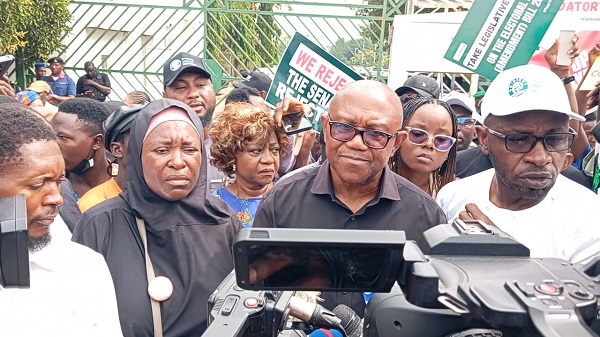
On February 9, 2026, former presidential candidate and political heavyweight Peter Obi led a major protest at the National Assembly Complex in Abuja, becoming the face of a growing national movement demanding comprehensive electoral reforms - specifically the mandatory real-time electronic transmission of election results. The demonstration - dubbed Occupy National Assembly - highlighted deep public frustration with the Senate’s handling of the Electoral Act Amendment Bill and raised urgent questions about electoral transparency ahead of the 2027 general elections. (ThisDayLive)
Hundreds of protesters - including student activists, civil society groups, members of the African Democratic Congress (ADC), and supporters of Obi’s Obidient Movement - converged on the entrance of Nigeria’s Parliament after mounting outrage over legislative decisions that critics say weaken safeguards against election manipulation. (Nigeria News Today)
Origins of the Protest: What Sparked the Outcry?
The demonstration was triggered by a controversial decision by the Senate to amend the Electoral Act 2022 (Repeal and Reenactment) Amendment Bill 2026. Lawmakers reportedly removed the explicit phrase “real-time electronic transmission” in a key clause dealing with how results are collated and shared after elections. Protesters argue that eliminating language requiring real-time reporting from polling units to the Independent National Electoral Commission (INEC) opens the door to manipulation before final results are made public. (TheCable)
Under prior provisions - and public expectations set after the flawed 2023 polls - real-time electronic data transfer was seen as essential to enhance transparency, reduce manual interference, and rebuild trust in Nigeria’s electoral outcomes. Observers contend that without legal mandates, INEC could be left with ambiguous directives on how to manage results transmission. (The Eagle Online)
Obi’s Message: “No More Glitch”
Addressing journalists and demonstrators outside the heavily fortified parliamentary complex, Obi delivered a forceful call for action. “We have suffered the danger before… We don’t want any glitch again,” he said, referencing the chaos that surrounded result collation and public distrust following past elections. “Simple transmission. It’s not a difficult thing… Why are you bringing this confusion?” (Politics Nigeria)
Obi insisted that the protest aims not to reject outcomes per se, but to ensure electoral systems are transparent and incontrovertible: “Allow the election to go through the normal process. Whoever wins, we would accept.”
Those sentiments resonated with many demonstrators who carried placards reading “Our Votes Must Count,” “Protect Democracy Now,” and “No to Electoral Robbery.” Many participants see the demand for real-time electronic transmission as a safeguard not merely against delays but against deliberate tampering with results after polling units close.
A Broad Coalition of Protesters
Obi was joined by prominent civil society figures and activists, including Aisha Yesufu, as well as grassroots organizations and student groups. These diverse constituencies reflect a broad base of Nigerians alarmed that the Senate’s recent move might weaken electoral accountability. (PM News Nigeria)
Security personnel were heavily deployed around the National Assembly, with the Nigeria Police Force, Nigerian Army, and Nigeria Security and Civil Defence Corps maintaining a visible presence to manage crowds and preserve order. Although protesters did not force their way into the complex, the demonstration remained intense and symbolic, with chants echoing across the parliamentary precinct. (Channels Television)
Senate Clarifications and Political Tensions
In response to public uproar, the Senate leadership has attempted to clarify its position, insisting that it did not reject electronic transmission outright - a claim that has done little to quell concerns. Protesters counter that wording changes dilute the legal requirement for automated, instantaneous transmission from polling units, potentially reverting to slower and more manipulable systems. (Punch Newspapers)
Before the protest, civil society groups, including the Nigeria Labour Congress (NLC) and Socio-Economic Rights and Accountability Project (SERAP), also raised alarms, threatening mass action or election boycotts should electoral protections be rolled back. These warnings fed into the momentum that brought thousands to the nation’s legislative seat. (The Guardian Nigeria)
Democratic Integrity at Stake
Opposition voices and activists underscore why this battle resonates beyond legal technicalities: credible elections are seen as the foundation of democratic legitimacy in Nigeria’s volatile political environment. Many Nigerians still remember the controversies of the 2023 general election, where technical glitches and delays in result announcements contributed to widespread allegations of manipulation and public distrust.
Justifying the call for robust transmission, Obi and his supporters argue that real-time electronic reporting acts as a check against opportunistic alterations during result collation, thereby reducing the possibility of rigging, tampering, or unequal access to information.
Broader Political Context
Obi’s leadership in the protest also reflects his evolving role in Nigeria’s political landscape as a voice for reform and governance accountability. A leading figure since his 2023 presidential run, Obi has consistently called for deeper institutional reforms - not only in electoral mechanisms but also in public finance, governance transparency, and democratic participation. (Nigeria Info, Let's Talk!)
Around the protest, tensions have grown over the content and intent of the Electoral Act Amendment Bill, which includes changes to timelines for election notices and other procedural amendments. The debate has quickly expanded into a broader discourse on how electoral laws should protect voter confidence and deter fraud - issues that will shape the 2027 elections and beyond. (Nigeria News Today)
Growing Momentum and Next Steps
As of the protest’s publication, demonstrators vow to sustain pressure until the National Assembly explicitly restores wording mandating real-time electronic transmission in the electoral law. The Obidient Movement and allied groups have not ruled out further actions or partnerships with other civil rights organizations should the legislature fail to respond.
On the legislative side, observers anticipate intense debate in committee and on the floors of both the Senate and the House of Representatives as the Electoral Act Amendment Bill moves closer to final passage. Whether protests like Occupy National Assembly will influence lawmakers’ decisions remains to be seen - but the political and societal implications are significant.
Why It Matters
At its core, the protest exemplifies a larger struggle over democratic accountability, transparency, and public confidence in Nigeria’s electoral system. As the nation prepares for another high-stakes general election in 2027, how the Electoral Act is written - especially regarding real-time transmission of results - will impact not only how votes are counted, but whether Nigerians trust the outcomes that shape the country’s future.
The presence of a major political figure like Peter Obi at the forefront of this movement underscores the depth of concern and the high stakes involved - not simply for one election cycle, but for the evolution of Nigerian democracy itself.