Nigerian Passengers Protest at Nairobi Airport Over Alleged Neglect After 24-Hour Flight Disruption
Nigerian passengers stranded at Nairobi's Jomo Kenyatta International Airport protested alleged neglect by Kenya Airways after flight delays and cancellations left them stranded for more than 24 hours.
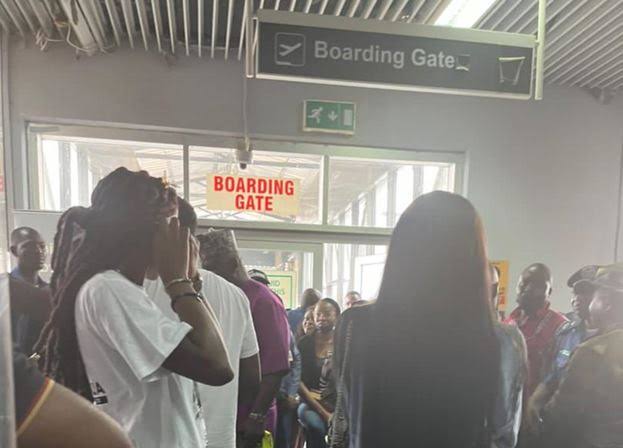
Tensions erupted at Jomo Kenyatta International Airport (JKIA) in Nairobi after Nigerian passengers stranded by widespread flight disruptions staged a protest over what they described as neglect and inadequate assistance from Kenya Airways.
The passengers, many of whom were travelling to Lagos, said they had been left waiting for more than 24 hours after repeated changes to their flight schedules failed to result in their departure.
Videos circulating from the airport showed heated exchanges between passengers and airline officials, while security personnel stood nearby as frustration among the stranded travellers intensified. (Punch)
The incident occurred against the backdrop of an industrial dispute involving Kenyan aviation workers that disrupted operations at JKIA and other airports across the country.
Passengers protest after repeated flight delays
According to reports, the protest began on Monday night after passengers endured hours of uncertainty over their onward flights.
Some Lagos-bound travellers said they had received several different departure times, only for the flights to remain grounded.
Tribune Online reported that passengers had initially expected a Nairobi-Lagos flight to depart at about 8:15 p.m., but the schedule was repeatedly changed. At different points, travellers were reportedly told the flight would leave at 6:15 p.m., 7 p.m. and eventually 10:50 p.m. (Tribune Online)
When the latest departure time passed without a clear indication that the flight would operate, frustration boiled over.
The passengers reportedly gathered inside the airport at about 10 p.m., demanding urgent intervention and clearer information about when they would be allowed to continue their journeys.
Some had already spent more than a day at the airport.
Nigerians accuse Kenya Airways of neglect
The immediate complaint from the stranded Nigerians was not simply the flight disruption itself but how they said they had been treated during the ordeal.
Passengers alleged that they received inadequate information about the status of their flights and insufficient welfare support while waiting.
Some reportedly said they had not been provided with accommodation despite spending the night at the airport.
Among those stranded was Bolaji Tunji, an aide to former Nigerian Minister of Power Bayo Adelabu.
Tunji said he had travelled from the United Kingdom and expected to arrive in Lagos by 11 a.m. Instead, he remained stranded in Nairobi.
He also highlighted the presence of a sick child among the passengers, describing the situation as particularly distressing.
The allegations have yet to be independently established as a failure by Kenya Airways, since the airline disruption was itself linked to wider industrial action affecting airport operations.
Air traffic controllers' strike disrupts Nairobi operations
The disruption at JKIA was connected to industrial action by Kenyan aviation workers, including air traffic controllers.
The strike caused significant disruption to flights arriving at and departing from Nairobi, with airlines forced to delay, cancel or reschedule services.
Reuters reported that the action affected thousands of passengers and continued into its second day before a return-to-work agreement was reached between the Kenya Aviation Workers Union, the Kenya Civil Aviation Authority, the Kenya Airports Authority and Jambojet. (Reuters)
The workers' grievances included disputes over collective bargaining agreements, salary reviews, union dues and alleged victimisation of union members.
The labour dispute therefore had consequences well beyond Kenya's borders because Nairobi is one of East Africa's major aviation hubs.
Passengers travelling between West Africa, East Africa, Europe, the Middle East and other destinations frequently use Nairobi as a connecting point.
Kenya Airways apologises for disruption
Kenya Airways acknowledged that the industrial action had caused significant disruption to its operations.
The airline said the strike had resulted in delays of more than six hours and created a backlog that forced the carrier to reschedule and cancel some flights.
Kenya Airways said its teams were working around the clock to manage the situation and minimise the impact on passengers.
The airline also advised travellers not to proceed to the airport unless they had a confirmed flight and urged them to check their flight status through its website or mobile application.
Passengers seeking to change or reschedule their journeys were reportedly allowed to do so without penalty.
Kenya Airways apologised for the inconvenience and said passenger and crew safety remained its highest priority.
Nigeria's aviation regulator intervenes
The situation also prompted intervention from the Nigeria Civil Aviation Authority (NCAA).
NCAA spokesperson Michael Achimugu said he contacted Kenya Airways' country manager after receiving reports about the stranded Nigerian passengers.
According to Achimugu, the airline's country manager assured the Nigerian regulator that the affected passengers would receive assistance.
The NCAA official specifically raised concerns about refreshments and the welfare of passengers who had been stranded for an extended period.
He said he instructed the airline to provide refreshments to Nigerians who had not received them.
The country manager reportedly confirmed that refreshments were being served at Gate 23.
Achimugu also explained that the disruption was not limited to Kenya Airways or Nairobi.
He said the strike was affecting flights across Kenya, meaning the airline's ability to operate normally was also constrained by the wider industrial action.
Airport disruption affects thousands
The Nigerian passengers' experience was part of a much larger disruption at Kenya's main international airport.
Reuters reported that the aviation workers' action caused widespread delays and cancellations, leaving passengers stranded for extended periods.
Some travellers were reportedly stuck for more than 12 hours, while airlines operating across East Africa adjusted schedules because of the disruption.
The industrial action was eventually ended following negotiations between the unions and government-linked aviation authorities.
Kenya's Transport Minister Davis Chirchir confirmed that stakeholders had agreed to address outstanding labour issues, including several collective bargaining agreements that had remained unresolved for years.
The resumption of work is expected to help restore normal flight operations, although the backlog created during the disruption could take time to clear.
A recurring concern for Nigerian travellers
The Nairobi incident has also revived concerns about the treatment of Nigerian passengers during international travel disruptions.
In February 2025, the NCAA publicly criticised Kenya Airways over its handling of another Nigerian passenger who became stranded at Nairobi airport.
The regulator at the time demanded an apology and compensation after an incident involving a Nigerian traveller who complained about a lengthy delay and lack of accommodation and care. (Premium Times Nigeria)
That earlier controversy means the latest protest is likely to receive heightened attention from Nigerian aviation authorities and travellers.
For passengers, the issue goes beyond whether a flight is delayed. They also expect airlines to provide accurate information and appropriate assistance when disruptions extend for many hours.
The importance of passenger welfare
Airline disruptions caused by circumstances outside a carrier's direct control can be extremely difficult to manage.
However, prolonged delays can create serious welfare concerns, particularly for passengers travelling with children, elderly people or individuals with medical conditions.
Clear communication becomes especially important when thousands of passengers are affected simultaneously.
Passengers need to know whether their flights will operate, when they will depart, whether accommodation is available and what alternative travel arrangements exist.
The absence of reliable information can quickly turn frustration into confrontation, as witnessed at JKIA.
What happens next?
With Kenyan aviation workers returning to duty, airlines are expected to work through the backlog of delayed and cancelled flights.
For the affected Nigerian passengers, the immediate priority is reaching their destinations after more than a day of uncertainty.
The incident also places pressure on Kenya Airways and Nigerian aviation authorities to ensure that passengers caught in future disruptions receive adequate assistance.
The airline's acknowledgement of the disruption and the NCAA's intervention could help calm tensions, but the broader question of passenger welfare remains.
A warning for Africa's aviation sector
The Nairobi airport protest highlights how quickly an industrial dispute at a major aviation hub can affect travellers from across Africa.
Nairobi's position as a major regional connecting point means that disruption there can have consequences for passengers travelling between continents.
For Nigerian travellers, the episode is another reminder of the risks associated with international connections and the importance of receiving timely information during major disruptions.
Ultimately, the incident demonstrates that flight cancellations are not merely scheduling problems. When passengers are left stranded for more than 24 hours without clear information, accommodation or adequate welfare support, the situation can become a serious humanitarian and customer-service issue.
As operations at JKIA return to normal, attention will now turn to whether Kenya Airways and other airlines can clear the backlog efficiently and whether lessons from the incident will lead to stronger contingency arrangements for passengers in future disruptions.