Nepal Tunnel Rescue: Two Workers Pulled Alive Nine Days After Deadly Flash Floods
Two hydropower workers have been rescued alive from a tunnel in Nepal nine days after devastating flash floods killed more than 1,300 people and left thousands missing.
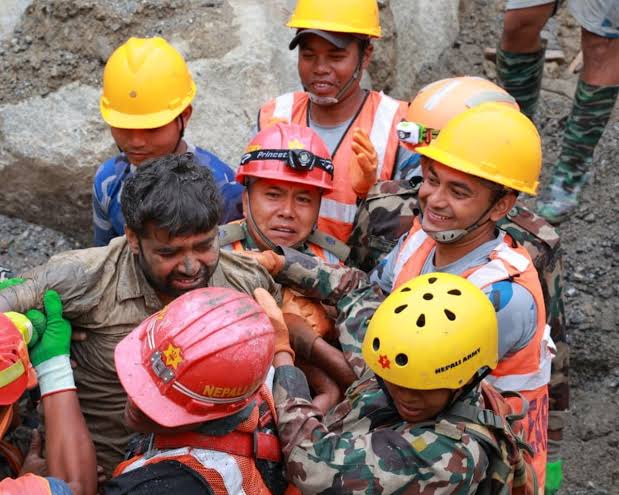
In a dramatic rescue that has raised fresh hopes for survivors, two workers have been pulled alive from a hydropower tunnel in Nepal nine days after catastrophic flash floods swept through the country.
The men, identified as Sanjay Sah and Kabir Maharjan, were rescued on Friday, September 4, from the Upper Trishuli 3A Hydropower Project in Nepal's Nuwakot/Rasuwa region. They had been trapped underground since August 26, when devastating flooding and landslides struck the Trishuli River corridor.
The rescue has been described as a remarkable breakthrough in an operation involving the Nepal Army, Armed Police Force, engineers and other emergency personnel. The two men were found approximately 170 metres inside the tunnel, where they had apparently survived in an underground section cut off by mud, water and debris. (Reuters)
Their survival has renewed hopes that other workers believed trapped in Nepal's extensive hydropower tunnel network may still be alive.
Two Workers Survive Against the Odds
The rescued workers have been identified as 30-year-old Sanjay Sah, a mechanical foreman with the Nepal Electricity Authority, and 45-year-old Kabir Maharjan, a mechanical supervisor.
Sah was working at the Trishuli 3A project when the flood struck. According to an account reported by the Kathmandu Post, he remained behind to help colleagues escape rather than immediately fleeing himself.
His decision ultimately left him trapped underground when floodwaters and debris overwhelmed access routes. (Kathmandu Post)
Maharjan had travelled to the hydropower facility for routine work when the disaster occurred.
After nine days underground, both men were eventually reached by rescuers and brought to the surface amid cheers from people gathered at the site.
Video released by Nepalese authorities showed mud-covered rescuers carrying Sah from the tunnel, while Maharjan was placed on a stretcher after being extracted. (The Guardian)
Injuries and Hospital Treatment
Although the two men survived the ordeal, their condition required immediate medical attention.
Reports indicate that Sah's injuries were not considered critical, while Maharjan was in a more serious condition and reportedly had difficulty moving his hands and legs.
Medical teams treated the survivors at the rescue site before they were transported to Kathmandu for further medical care.
Sah was reportedly provided with oxygen during his initial treatment, while doctors checked his vital signs before he was transferred to hospital. (ABC News)
The physical condition of the two survivors also illustrates the enormous challenges faced by people trapped underground for more than a week without normal access to food, water, medical care and fresh air.
How the Rescue Operation Unfolded
The rescue operation was particularly difficult because the flooding had filled sections of the hydropower infrastructure with mud, rocks and debris.
Rescuers had to work through unstable and heavily obstructed areas while attempting to determine whether people were still alive inside the tunnels.
The Nepal Army and Armed Police Force used heavy equipment and technical expertise to clear routes and reach sections of the underground facility.
Rescue teams also worked with engineers familiar with the hydropower project, using technical plans and information about the tunnel structure to determine where trapped workers could potentially be located.
Reports indicate that oxygen was pumped into parts of the tunnel during the operation, while rescuers drilled and created access points to reach the trapped men. (The Irish Sun)
The rescue demonstrates how engineering knowledge became as important as conventional emergency response in reaching people trapped deep beneath the ground.
Hopes Rise for More Survivors
The successful rescue of Sah and Maharjan has provided a significant psychological boost to families waiting for information about missing relatives.
Before the two men were found, concerns were growing that workers trapped inside the tunnels might not have survived the flooding.
Authorities estimate that approximately 900 workers remain unaccounted for across 12 hydropower projects, with roughly 500 believed to be trapped inside tunnels.
The situation has made the hydropower facilities one of the most challenging areas of the country's wider search-and-rescue operation.
Rescue teams are continuing to search other sites, particularly areas where there may be air pockets capable of sustaining people trapped underground.
The discovery of two survivors after nine days has therefore changed expectations about what may still be possible.
A Disaster of Extraordinary Scale
The tunnel rescue is taking place against the backdrop of one of Nepal's worst recent natural disasters.
The flooding began on August 26 after a glacier-related event near the Nepal-Tibet border triggered enormous volumes of water and debris through river valleys.
The resulting floods devastated communities, damaged roads and bridges, and severely affected hydropower infrastructure.
Reuters reported that the disaster had killed more than 1,300 people and left more than 5,600 missing, while hundreds of foreign nationals were also among those affected.
The floods also caused extensive economic damage.
According to Reuters, the disaster destroyed infrastructure and property estimated at around $2.56 billion, while thousands of people were displaced and the government faces the enormous task of rebuilding homes and essential infrastructure.
Hydropower Projects Particularly Vulnerable
Nepal has invested heavily in hydropower because of its enormous river systems and mountainous terrain.
The industry is therefore strategically important to the country's economy and energy security.
However, the disaster exposed the vulnerability of hydropower infrastructure to extreme weather events, particularly in mountainous areas where tunnels, access roads and power facilities can be isolated or damaged by floods and landslides.
The August 26 disaster affected multiple hydropower projects along the Trishuli and Bhotekoshi river systems.
Rescuers have faced the difficult combination of remote terrain, destroyed roads, blocked tunnels and limited access to heavy rescue equipment.
Technology and Coordination Aid Rescue Efforts
The search for survivors has also involved technology beyond conventional rescue equipment.
Drone operators have been helping emergency teams survey devastated areas that are difficult or dangerous for people to reach.
Thermal drones and drones equipped with speakers have been used in attempts to locate stranded people and establish communication.
At the hydropower projects, engineers have contributed technical knowledge about tunnel layouts, while rescue teams have coordinated their activities with specialists through communication networks.
The successful recovery of the two workers demonstrates the importance of combining military rescue capabilities, engineering expertise, technology and local knowledge during complex disasters.
A Story of Survival and Hope
For Nepal, the rescue of Sanjay Sah and Kabir Maharjan has provided a rare moment of hope amid an otherwise devastating national tragedy.
Their survival for nine days underground demonstrates the possibility that people trapped in isolated sections of tunnels can remain alive even when rescuers initially struggle to reach them.
Sah's account that he stayed behind to help colleagues adds another human dimension to the story, highlighting the courage of workers caught in an unprecedented emergency.
For families still waiting for news, the rescue has renewed hopes that their loved ones may also be found alive.
Search Operation Continues
Despite the successful rescue at Trishuli 3A, the broader emergency is far from over.
Hundreds of workers remain missing, and rescue teams continue efforts to reach blocked tunnels and other isolated areas.
Authorities must also contend with the enormous task of recovering bodies, identifying victims, supporting displaced families and restoring damaged infrastructure.
The two survivors' rescue, however, has demonstrated that hope should not be abandoned while search operations remain technically possible.
Nine days after Nepal's devastating flash floods, two men emerged from the darkness alive.
Their extraordinary survival has become one of the most powerful stories of hope from a disaster that has otherwise brought death, destruction and uncertainty to thousands of families across Nepal.