Massive Crowds Flood Tehran Streets for Ayatollah Ali Khamenei's Funeral Procession Amid Tight Security
Hundreds of thousands of mourners packed the streets of Tehran for the funeral procession of Iran's Supreme Leader Ayatollah Ali Khamenei. The historic ceremony drew senior officials, foreign dignitaries, and citizens in one of the largest public gatherings in recent Iranian history.
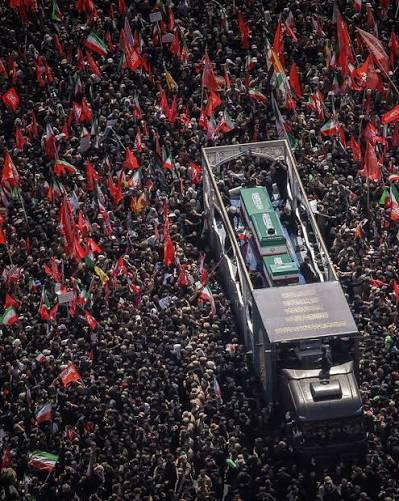
Tehran witnessed one of the largest public gatherings in Iran's modern history as hundreds of thousands of mourners filled the capital's streets for the funeral procession of the country's longtime Supreme Leader, Ayatollah Ali Khamenei.
From the early hours of the morning, vast crowds dressed predominantly in black converged on major avenues leading to central Tehran, waving Iranian flags, carrying portraits of Khamenei, and chanting religious slogans as the funeral cortege made its way through the city. State media described the turnout as "historic," while aerial footage showed roads packed with mourners stretching for several kilometers.
The funeral marked the end of an era in Iranian politics, following Khamenei's death after more than three decades as the nation's highest political and religious authority. Since assuming leadership in 1989 after the death of Ayatollah Ruhollah Khomeini, Khamenei had become the central figure in shaping Iran's domestic governance, foreign policy, and regional strategy.
Historic Gathering in the Iranian Capital
Authorities declared a public holiday to enable citizens to participate in the ceremonies, while government offices, schools, universities, and many businesses remained closed throughout the day.
Crowds lined the procession route hours before the ceremony began, with many mourners carrying flowers, Qur'ans, and banners bearing messages of tribute. Volunteers distributed drinking water, food, and refreshments as temperatures climbed during the day.
State television broadcast continuous live coverage from multiple locations across Tehran, capturing emotional scenes of mourners praying, weeping, and chanting as the coffin, draped in the Iranian flag, was transported through the city.
Officials estimated attendance in the hundreds of thousands, although independent verification of the crowd size was not immediately available.
Senior Leaders and Foreign Delegations Attend
The funeral drew Iran's political, military, and religious leadership, including senior government officials, members of parliament, commanders of the Islamic Revolutionary Guard Corps (IRGC), and prominent clerics.
Representatives from several allied countries across the Middle East, Asia, Africa, and Latin America also attended the ceremony, reflecting Khamenei's influence beyond Iran's borders.
Messages of condolence continued to arrive from governments around the world, while numerous regional leaders acknowledged Khamenei's decades-long role in shaping Middle Eastern geopolitics.
Security around the ceremony was exceptionally tight, with thousands of police officers, Revolutionary Guard personnel, and emergency responders deployed throughout the capital. Authorities established extensive security checkpoints along major roads leading into central Tehran and temporarily restricted traffic in several districts.
Despite the heightened security, the event proceeded without any major reported incidents.
A Leader Who Shaped Modern Iran
Khamenei's leadership spanned some of the most consequential periods in Iran's recent history.
During his tenure, the country navigated international sanctions, diplomatic confrontations, regional conflicts, nuclear negotiations, and significant domestic political challenges.
Supporters viewed him as the guardian of the Islamic Republic and a symbol of resistance against foreign pressure, while critics argued that his administration oversaw increasing political restrictions and economic difficulties.
Regardless of political perspectives, few dispute the profound influence Khamenei wielded over Iran's political institutions and strategic direction during his more than three decades in office.
His passing now ushers in a critical transition period as Iran's Assembly of Experts undertakes the constitutional process of selecting the country's next Supreme Leader.
Emotional Farewell Across the Nation
Although the main ceremony took place in Tehran, memorial services were simultaneously held in cities and towns across Iran.
Mosques organized special prayers, while giant screens erected in public squares broadcast the funeral live for citizens unable to travel to the capital.
Many mourners interviewed by Iranian state media described attending the funeral as both a religious duty and a personal expression of gratitude.
Others said they wanted to witness what they believed would become one of the defining historical moments of their generation.
Families attended together, with elderly citizens walking alongside young children, underscoring the significance many Iranians attached to the occasion.
Global Attention Focuses on Iran's Future
International observers closely monitored the funeral, not only because of its symbolic importance but also because of the political transition now underway.
Analysts say the appointment of Iran's next Supreme Leader will significantly influence the country's domestic policies, economic reforms, nuclear negotiations, and relationships with neighboring states and Western governments.
Financial markets and regional governments have also been watching developments closely, given Iran's strategic importance in global energy markets and Middle Eastern security.
Several world leaders issued statements expressing condolences while calling for stability during the transition period.
Extensive Security Measures
Authorities implemented one of the largest security operations seen in Tehran in recent years.
Public transportation services were expanded to accommodate the massive influx of mourners, while medical teams and emergency response units were stationed throughout the city.
Drone surveillance, helicopters, and additional communications equipment were deployed to monitor crowd movement and coordinate emergency services.
Officials urged participants to remain patient and cooperate with security personnel as millions navigated the capital's streets during the lengthy ceremony.
Burial and National Mourning
Following the procession, Khamenei was laid to rest during a private burial ceremony attended by family members, senior clerics, and top government officials.
Iran has also announced an extended period of national mourning, during which flags will fly at half-staff and commemorative events will continue nationwide.
State institutions are expected to organize additional memorial gatherings over the coming days, while religious ceremonies honoring the late Supreme Leader are planned in major cities across the country.
A Defining Moment in Iranian History
The funeral procession represented more than the farewell to a single political leader. It marked the conclusion of a chapter that shaped Iran for over three decades and signaled the beginning of a new and uncertain political era.
Whether viewed through the lens of politics, religion, or history, the images of Tehran's streets filled with vast crowds will likely remain among the defining moments of contemporary Iran.
As the nation enters its next phase of leadership, attention now turns to the constitutional succession process and the decisions that will shape the Islamic Republic's future in the years ahead.