Massive Attack Responds After Singapore Ban Over Palestine Flag Display at Concert
British band Massive Attack has responded after Singapore barred two of its members from re-entering the country following a pro-Palestinian display during a concert. Here's what happened, the band's response, and the wider debate over free expression.
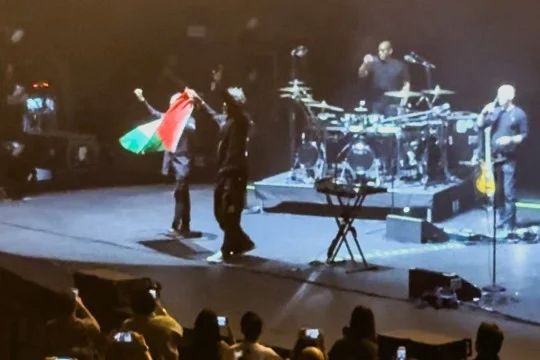
British trip-hop band Massive Attack has expressed disappointment and surprise after Singapore banned two of its founding members from re-entering the country over a pro-Palestinian display during a recent concert.
The controversy erupted after the band's July 29 performance at the Star Theatre in Singapore, where founding members Robert "3D" Del Naja and Grant "Daddy G" Marshall unfurled a Palestinian flag on stage and joined audience members in chanting "Free Palestine." Singaporean authorities subsequently investigated the incident, issued stern warnings to the musicians, and permanently barred them from returning to the city-state, citing laws designed to preserve racial and religious harmony. (Reuters)
Singapore Takes Swift Action
Following the concert, Singapore Police said the musicians had violated laws prohibiting the public display of foreign national emblems and expressions of support for foreign political causes without official approval.
Authorities argued that such actions could undermine Singapore's carefully maintained racial and religious harmony in its multicultural society.
The Ministry of Digital Development and Information (MDDI) and the Infocomm Media Development Authority (IMDA) also announced that Massive Attack would no longer be permitted to perform in Singapore. The two musicians were detained for questioning, their hotel rooms were searched, and their passports were temporarily confiscated before they were allowed to leave the country.
Massive Attack Responds
In a statement released after the incident, Massive Attack said it was "surprised and disappointed" by the authorities' response.
The band said it had not anticipated that displaying the flag of Palestine - a territory recognised as a state by more than 140 UN member states would constitute a violation of Singaporean law.
Massive Attack also noted that the "Free Palestine" chants originated from members of the audience before the band joined in, describing the moment as a spontaneous expression of solidarity rather than a pre-planned political demonstration.
The group further called on Singapore to support freedom of conscience and peaceful expression, arguing that artistic performances should remain spaces where humanitarian concerns can be expressed without fear of punishment.
Singapore Defends the Ban
Singaporean officials defended their decision, stressing that the country maintains strict neutrality regarding foreign conflicts and prohibits public demonstrations that could inflame domestic tensions.
Police said the display of a foreign national emblem without authorisation, combined with public political messaging, breached regulations intended to prevent imported conflicts from affecting Singapore's diverse population.
Officials emphasised that the restrictions were not directed at a particular political viewpoint but were intended to preserve public order and social cohesion.
Singapore has long maintained strict rules governing public assemblies, political demonstrations, and the display of foreign national symbols, arguing that such policies are necessary in a country with significant ethnic and religious diversity. (AP News)
Longstanding Advocacy for Palestine
The incident is consistent with Massive Attack's long history of political activism.
For decades, the Bristol-based band has spoken publicly in support of Palestinian rights and has boycotted performances in Israel as part of its broader political stance. The group has also supported humanitarian organisations working with Palestinian refugees and has frequently incorporated political messaging into its concerts.
In recent years, Massive Attack has joined campaigns calling for greater international attention to the humanitarian situation in Gaza and has defended artists who have expressed pro-Palestinian views during performances. (Wikipedia)
Debate Over Freedom of Expression
The Singapore ban has reignited international debate over the balance between freedom of artistic expression and national laws regulating political activity.
Supporters of the ban argue that displaying a Palestinian flag was a peaceful humanitarian gesture protected by freedom of expression.
Critics, however, contend that performers visiting another country should respect local laws, regardless of whether they agree with them.
Human rights organisations have frequently criticised Singapore's strict controls on public assemblies and political expression, while Singaporean authorities insist such regulations are essential to maintaining stability in a multicultural nation. (The Guardian)
Fans React
The decision has generated widespread discussion on social media, with fans and fellow musicians expressing differing views.
Some praised Massive Attack for standing by its principles despite the consequences, while others argued that artists should avoid introducing geopolitical issues into live performances, particularly in countries with strict regulations.
The incident has also drawn attention to the increasing intersection between music, activism, and international politics, where performers are increasingly using concerts as platforms to highlight humanitarian causes.
A Growing Trend of Artist Activism
Massive Attack is not the only music act to face controversy over political expression.
In recent years, several international artists have publicly commented on global conflicts, climate change, racial justice, and human rights during concerts and award ceremonies.
These actions have sometimes resulted in government criticism, cancelled performances, or restrictions in countries with strict public-order laws.
The Singapore incident reflects the growing challenges faced by internationally touring artists as political activism increasingly intersects with differing national legal systems.
What Happens Next?
While Massive Attack has indicated it remains committed to supporting humanitarian causes, the Singapore government has not indicated that it will reconsider its decision.
The two musicians remain barred from re-entering Singapore, and the band is no longer permitted to perform there under current regulations.
The episode is likely to remain a significant case study in the ongoing global debate over artistic freedom, political expression, and the limits imposed by national laws. As artists continue to use their platforms to address international issues, governments and performers alike will face difficult questions about where the boundaries between free expression and legal compliance should be drawn.