Large-Scale Russian Attack on Ukraine Leaves Four Dead, Dozens Injured as Kyiv Endures Massive Missile Barrage
Russia launched one of its biggest missile and drone assaults on Ukraine in 2026, killing at least four people and injuring dozens in Kyiv and surrounding regions as tensions in the war escalated sharply.
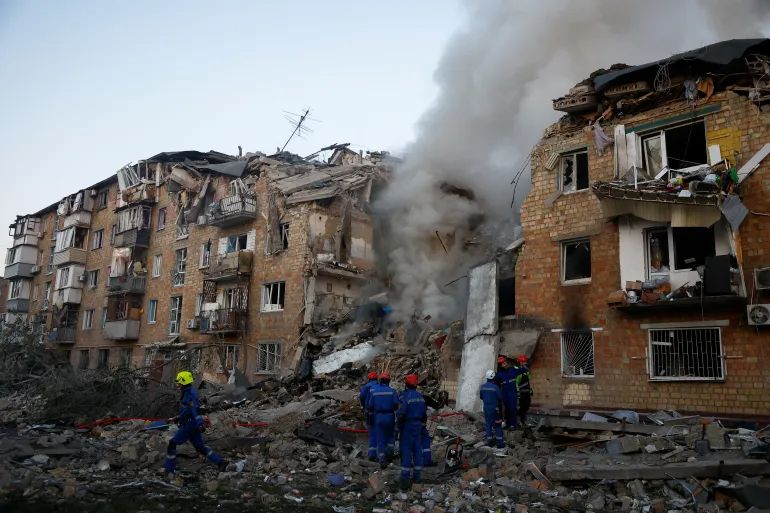
Russia unleashed one of its largest aerial assaults on Ukraine in recent months, killing at least four people and injuring dozens more in a massive overnight attack that targeted Kyiv and surrounding regions with missiles, drones, and hypersonic weaponry.
The large-scale bombardment, which took place in the early hours of May 24, 2026, sent residents scrambling for shelter as explosions rocked multiple districts of the Ukrainian capital. Ukrainian authorities said the coordinated strike involved hundreds of drones and dozens of missiles, including the use of Russia’s nuclear-capable Oreshnik hypersonic ballistic missile for the third time since the war began.
According to Ukrainian officials, two people were killed in Kyiv itself, while two others died in the wider Kyiv region. More than 80 people were reported injured across the country, with at least 56 casualties recorded in the capital alone. (The Washington Post)
The assault marked another dangerous escalation in the more than four-year conflict between Russia and Ukraine, which has increasingly involved long-range missile strikes, drone warfare, and attacks on critical infrastructure.
Explosions Rock Kyiv Overnight
Residents across Kyiv described hearing repeated explosions shortly after air raid sirens sounded around 1 a.m. local time. Videos and photographs circulating online showed burning buildings, shattered apartment blocks, damaged schools, and emergency crews battling fires across several districts.
Kyiv Mayor Vitali Klitschko confirmed that residential neighborhoods, educational institutions, and infrastructure facilities were among the sites hit during the barrage. Ukrainian military officials said damage was recorded in at least 40 locations throughout the capital. (Al Jazeera)
One school building reportedly sustained damage while civilians sheltered inside during the attack. Fires also broke out in commercial areas and residential complexes, forcing emergency workers to conduct overnight rescue operations.
Ukraine’s Air Force stated that Russia launched approximately 600 drones and 90 missiles during the assault. Although many projectiles were intercepted by Ukrainian air defenses, several succeeded in striking their intended targets.
The attack reportedly continued even after sunrise, with officials warning residents to remain in shelters amid fears of additional missile launches.
Russia Deploys Oreshnik Hypersonic Missile
One of the most alarming aspects of the strike was Russia’s use of the Oreshnik intermediate-range ballistic missile, a hypersonic weapon capable of carrying nuclear warheads.
Ukrainian President Volodymyr Zelenskyy confirmed the missile’s use and condemned the attack as an act of terror aimed at intimidating civilians and damaging Ukraine’s infrastructure. (euronews)
The Oreshnik missile has drawn significant international attention because of its speed and difficulty in intercepting. Analysts have warned that its deployment represents a major escalation in Russia’s military strategy.
Russia’s Defense Ministry claimed the strikes were retaliatory measures in response to alleged Ukrainian attacks on civilian targets in Russian-controlled territories. Moscow said it had targeted military infrastructure and strategic facilities, denying accusations that it deliberately targeted civilians.
However, Ukrainian authorities argued that the widespread damage to residential areas, schools, and civilian infrastructure demonstrated the indiscriminate nature of the assault.
International Alarm and Diplomatic Fallout
The attack sparked swift condemnation from European leaders and renewed calls for stronger international action against Moscow.
European Union foreign policy officials described the strike as an act of civilian terror and warned that Russia’s use of hypersonic weaponry increased the risk of broader regional instability. Discussions about expanding sanctions and increasing military support for Ukraine were expected to dominate upcoming EU meetings.
The assault also deepened concerns over the stalled peace negotiations reportedly being facilitated by the United States and European partners. U.S. officials acknowledged growing frustration over the lack of diplomatic progress, while Ukrainian officials insisted that continued Russian attacks made negotiations increasingly difficult.
The United Nations Security Council was also expected to convene emergency discussions regarding the latest escalation.
Humanitarian Concerns Grow
Beyond the immediate casualties, humanitarian agencies expressed growing concern about the continued targeting of civilian infrastructure.
The World Health Organization confirmed that debris from ongoing strikes damaged offices in Kyiv housing several UN agencies. WHO Director-General Tedros Adhanom Ghebreyesus renewed calls for an immediate ceasefire and greater protection for humanitarian workers operating in Ukraine. (The Times of India)
Emergency services continued rescue and recovery efforts throughout Sunday as authorities assessed the full scale of destruction.
Residents interviewed by local media described scenes of panic and exhaustion after another night spent in underground shelters.
Many Kyiv residents said the intensity of the latest assault ranked among the worst attacks the city had experienced in recent months.
Escalating Drone Warfare
The latest Russian assault came amid an increasingly aggressive phase of drone warfare between the two countries.
Earlier in the week, Ukraine launched one of its largest drone attacks on Russian territory, reportedly targeting Moscow and several other regions. Russian authorities said those strikes killed at least four people and injured more than a dozen others. (ITVX)
Military analysts say both Russia and Ukraine have expanded their use of drones because they are cheaper, harder to intercept, and capable of reaching targets deep behind enemy lines.
The intensifying exchange of long-range attacks has heightened fears that the war could spiral further out of control, especially as more advanced missile systems continue to be deployed.
War With No Immediate End in Sight
As the conflict drags deeper into its fifth year, the latest attack underscored the continuing volatility of the Russia-Ukraine war and the enormous human toll it continues to inflict.
Despite repeated diplomatic initiatives, neither side has shown signs of backing down, while civilians continue to bear the brunt of the violence.
For many Ukrainians, the massive overnight bombardment served as another grim reminder that peace remains elusive, even as global attention increasingly shifts toward other international crises.
With tensions rising and both sides intensifying aerial attacks, fears are growing that even larger and deadlier confrontations could still lie ahead.