Kim Jong Un Opens Memorial for North Korean Soldiers Killed in Ukraine War in Rare Public Tribute
North Korean leader Kim Jong Un has inaugurated a memorial museum in Pyongyang honoring soldiers killed while fighting alongside Russia in the Ukraine war. Here’s what the ceremony means for North Korea-Russia relations and global tensions.
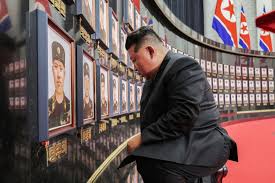
North Korean leader Kim Jong Un has inaugurated a major memorial museum in Pyongyang dedicated to North Korean soldiers killed while fighting alongside Russian forces in the ongoing war in Ukraine. The ceremony, held on April 26, 2026, marks one of the most significant public acknowledgements yet of North Korea’s military involvement in the conflict.
The event, attended by senior Russian officials including Defense Minister Andrei Belousov and State Duma Speaker Vyacheslav Volodin, underscores the deepening military alliance between Pyongyang and Moscow at a time of escalating global tensions. (Korea Joongang Daily)
A Memorial Built on Battlefield Losses
The newly opened facility, known as the Memorial Museum of Combat Feats at Overseas Military Operations, was constructed to honor North Korean troops deployed to Russia’s war effort in Ukraine, particularly in the contested Kursk region.
State media reports indicate that the museum also includes a burial site for fallen soldiers, with ceremonies planned for mid-April to inter remains of those killed in combat. (NK News - North Korea News)
Inside the complex, exhibits reportedly display:
- Portraits of fallen soldiers
- Battlefield narratives from the Kursk operation
- Captured Western military equipment
- Symbolic displays of North Korea-Russia “combat brotherhood”
The memorial is designed not only as a tribute but also as a political statement reinforcing loyalty to Kim’s leadership and ideology.
Kim Jong Un’s Message: “Sacrifice for a Just War”
During the inauguration, Kim Jong Un praised the soldiers for what he called “unrivalled bravery and noble sacrifice,” framing their deaths as part of a “just and sacred war” alongside Russia against Western influence.
He further described the Russia-North Korea alliance as a “powerful stronghold” against what he referred to as Western “hegemony,” reinforcing Pyongyang’s ideological alignment with Moscow.
Kim also paid tribute to soldiers who died in combat and, in rare language, praised their “heroic spirit” and battlefield commitment, presenting them as national martyrs.
Russian Officials Attend High-Profile Ceremony
The memorial opening was not solely a domestic North Korean event. It was also a diplomatic spectacle involving high-level Russian participation.
According to reports, Russian Defence Minister Andrei Belousov and senior parliamentary figures attended the ceremony alongside Kim Jong Un.
Russian officials reportedly expressed gratitude for North Korea’s military support in Ukraine, particularly during operations in the Kursk region. The presence of Moscow’s delegation signals a deepening strategic partnership between the two countries following their 2024 defence cooperation treaty.
How Many North Korean Soldiers Died?
Although official numbers remain undisclosed by Pyongyang, intelligence estimates cited by regional analysts suggest:
- Thousands of North Korean troops were deployed to Russia
- A significant number were killed or injured in Ukraine-related operations
- Casualty estimates vary widely, with some suggesting around 2,000 deaths or more
These figures remain difficult to independently verify, as both Russia and North Korea tightly control battlefield information. (Arab News)
South Korean intelligence has long reported that North Korea has supplied not only troops but also missiles and munitions to support Russia’s war effort.
From Secret Deployment to Public Recognition
For much of the war, North Korea’s involvement was covert or only partially acknowledged. However, in recent months, Pyongyang has shifted toward open recognition of its military role in Ukraine.
Earlier ceremonies already honored fallen troops, but the new museum represents a major escalation in visibility and propaganda value. (NK News - North Korea News)
Analysts say the shift suggests Kim Jong Un is now:
- Consolidating domestic support through wartime nationalism
- Rewarding military loyalty
- Strengthening strategic ties with Russia
- Using battlefield sacrifice to reinforce regime legitimacy
Strengthening Russia-North Korea Alliance
The memorial comes amid rapidly expanding cooperation between Pyongyang and Moscow.
Recent developments include:
- A mutual defence agreement signed in 2024
- Increased military exchanges and visits
- Reports of technology and economic aid flowing to North Korea in exchange for military support
- Plans for long-term cooperation agreements extending beyond 2027 (AP News)
Russia has publicly thanked North Korea for its assistance in Ukraine, while both countries increasingly frame their relationship as a joint stand against Western influence.
International Reaction and Concerns
The memorial has drawn concern from Western governments, which view it as evidence of deepening authoritarian military alignment.
Security analysts warn that the partnership could:
- Prolong the Ukraine war
- Increase weapons proliferation risks
- Strengthen North Korea’s missile and nuclear capabilities through Russian assistance
- Destabilize Northeast Asian security balances
Ukrainian and Western officials also argue that North Korean troops, initially inexperienced, have gained battlefield exposure that could make them more effective in future conflicts. (Al Jazeera)
A Symbol of a New Geopolitical Axis
The Pyongyang memorial is more than a domestic tribute, it is a geopolitical statement.
By publicly honoring soldiers who died fighting in Europe’s largest war since World War II, North Korea is:
- Cementing its role as a military ally of Russia
- Reinforcing anti-Western rhetoric
- Signaling readiness for deeper global confrontation politics
For Kim Jong Un, the memorial serves multiple purposes: domestic propaganda, military morale building, and international signaling.
Final Analysis
Kim Jong Un’s decision to open a memorial for soldiers killed in Ukraine marks a turning point in North Korea’s public posture on the war. What was once a covert military contribution is now being elevated into national mythology.
The move strengthens the Pyongyang-Moscow alliance while further isolating North Korea from the West. At the same time, it raises questions about the long-term consequences of a partnership built on shared conflict, sanctions pressure, and geopolitical confrontation.
As the Ukraine war continues, the memorial stands as a stark reminder that its reach now extends far beyond Europe deep into East Asia’s most secretive state.