Israel Reopens Ganim Settlement in West Bank, Defying Growing International Opposition
Israel has re-established the Ganim settlement in the occupied West Bank, more than 20 years after its evacuation, as international opposition to Israeli settlement expansion intensifies.
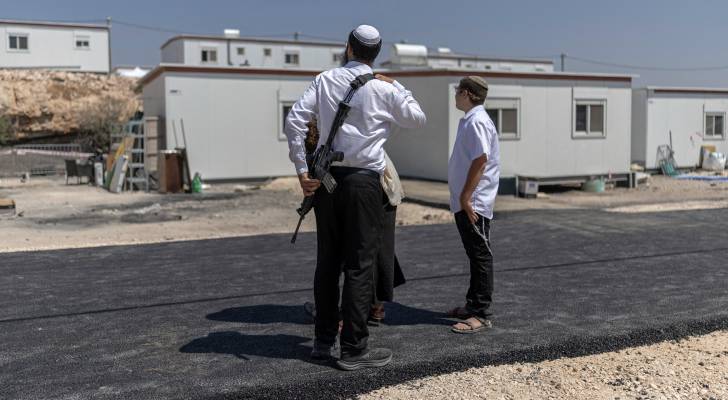
Israel has re-established the Ganim settlement in the occupied West Bank, more than two decades after it was evacuated under the country's 2005 disengagement plan, in a move that has intensified international criticism of Israel's expanding settlement policy.
Around 30 Israeli families have moved into the rebuilt settlement, accompanied by far-right Finance Minister Bezalel Smotrich and other Israeli officials. The development marks the return of permanent Israeli civilian presence to a site that was abandoned in 2005 and comes amid a broader acceleration of settlement construction and expansion across the West Bank. (Asharq Al-Awsat)
The move is particularly significant because it follows years of growing international opposition to Israeli settlements in territory Palestinians claim for a future independent state.
Ganim returns after 21 years
Ganim, located in the northern West Bank near Jenin, was one of four Israeli settlements evacuated as part of former Prime Minister Ariel Sharon's 2005 disengagement plan.
The plan removed Israeli settlers from four communities in the northern West Bank—Ganim, Kadim, Homesh and Sa-Nur as well as all Israeli settlements in the Gaza Strip.
More than 20 years later, Israeli authorities have reversed course at Ganim.
According to reports, newly constructed infrastructure, including a road and prefabricated homes, has been prepared for returning residents. The first families have now begun moving into the settlement, turning what had been an evacuated site into an active Israeli community once again. (Al-Monitor)
The reopening is being celebrated by Israel's settlement movement as a symbolic reversal of the 2005 withdrawal.
Smotrich leads return
Finance Minister Bezalel Smotrich, one of the most prominent figures in Israel's far-right government and a vocal advocate of expanding Jewish settlements, accompanied families moving into Ganim.
Smotrich has repeatedly argued that Israel should strengthen its control over the West Bank and reject the establishment of a Palestinian state.
His presence at the Ganim ceremony therefore carries considerable political significance.
The reopening is not an isolated development. It forms part of a wider government policy that has accelerated settlement expansion, legalised previously unauthorised outposts and expanded Israeli administrative control over parts of the West Bank.
In June, Reuters reported that Israel had approved 2,162 new homes in Jewish settlements in the West Bank, while the government continued to push a broader settlement programme. (Reuters)
A reversal of the 2005 disengagement
The Ganim development is particularly important because the settlement had been deliberately dismantled as part of a policy intended to reduce Israeli military and civilian exposure in the area.
The 2005 disengagement was one of the most consequential Israeli decisions concerning settlements in the Palestinian territories.
However, Israel's parliament in 2023 repealed provisions that had prevented Israelis from entering the evacuated northern West Bank settlements, paving the way for efforts to return to some of the sites.
The repeal was followed by renewed attempts by settlers to establish a permanent presence in areas evacuated nearly two decades earlier. (Wikipedia)
Ganim's reopening therefore represents the practical outcome of a policy shift that began several years ago.
International community strongly opposed
The move comes against a backdrop of increasingly strong international opposition to Israeli settlement expansion.
Most countries and international organisations consider Israeli settlements in the occupied West Bank illegal under international law, particularly under interpretations of the Fourth Geneva Convention governing the treatment of populations in occupied territories.
Israel disputes that legal interpretation and maintains historical, religious and security claims to the West Bank.
Nevertheless, the latest expansion has generated criticism from Israel's traditional allies as well as other governments.
The controversy has intensified further because Israel is simultaneously advancing plans for additional settlement construction in strategically important parts of the West Bank.
E1 settlement plan raises alarm
One of the most controversial developments is Israel's plan to build approximately 1,200 housing units in the E1 area, east of Jerusalem.
E1 is considered strategically important because construction there could divide the northern and southern portions of the West Bank and make the creation of a geographically contiguous Palestinian state more difficult.
Britain has condemned the latest E1 settlement tender as “unacceptable and destructive” and summoned Israel's ambassador over the issue. (Haaretz)
Other European governments have also expressed opposition.
Recent international criticism has included statements from Britain, France, Germany, Italy and Canada, which have condemned Israeli plans to expand settlements in the West Bank.
The United Nations has also warned that the E1 project could pose a serious threat to the possibility of establishing a viable and contiguous Palestinian state. (The Business Standard)
Settlement expansion accelerates
Ganim's reopening comes as Israel's settlement movement expands its activities across the West Bank.
Reuters reported in June that the Israeli government was advancing a major settlement programme, including thousands of new housing units.
In December 2025, Israel's cabinet also approved legal status for 19 settlements, including communities located on sites evacuated two decades earlier. (Reuters)
The government has additionally considered allocating around 1 billion shekels ($339.7 million) for new settlements and related infrastructure. The plan was promoted by Smotrich, who has openly opposed Palestinian statehood.
Taken together, these measures indicate a sustained government strategy rather than isolated settlement initiatives.
Palestinians fear loss of land
Palestinian officials and rights organisations argue that settlement expansion is contributing to the gradual loss of Palestinian land and undermining the possibility of an independent Palestinian state.
The West Bank is home to approximately 3.3 million Palestinians and hundreds of thousands of Israeli settlers.
The expansion of Israeli communities, roads and infrastructure can fragment Palestinian communities and restrict access to agricultural land and natural resources.
Recent reports have also highlighted increased settler violence.
Reuters reported that Palestinian residents of Qusra, a West Bank village, had experienced months of attacks by militant settlers, with more than 2,200 Palestinians reportedly displaced across the West Bank during 2026 because of settler violence. (Reuters)
Human rights organisations say the combination of settlement expansion and settler violence is creating growing pressure on Palestinian communities to leave their homes.
US pressure on Israel
Even Washington, traditionally Israel's most important international ally, has expressed concern over some developments in the West Bank.
The United States recently urged Israeli Prime Minister Benjamin Netanyahu to publicly condemn a siege imposed by Israeli settlers on Palestinian homes in Qusra.
US Ambassador to Israel Mike Huckabee also warned settlers against seizing property belonging to Palestinian Americans and described such actions as violations of law.
However, Washington's approach remains complex.
The United States has historically supported Israel's security while opposing some settlement policies, and the Trump administration has not adopted the same approach to settlements as previous US governments.
The result is increasing tension between American diplomatic concerns and the Israeli government's settlement agenda.
What Ganim means for the Palestinian state debate
The return to Ganim has implications beyond the settlement itself.
The location of the settlement in the northern West Bank makes its re-establishment significant for Palestinian territorial continuity.
The broader settlement strategy could make negotiations over borders increasingly complicated if Israeli communities become permanently embedded throughout territory claimed by Palestinians.
Critics argue that every new settlement and expanded outpost creates additional facts on the ground that could make a negotiated two-state solution more difficult.
Israeli settlement advocates, however, reject that argument and contend that Jewish communities have a historical and security-based right to live in the West Bank.
A new phase in Israel's settlement policy
The reopening of Ganim demonstrates how dramatically Israel's West Bank policy has changed since the 2005 disengagement.
What was once a symbol of Israeli withdrawal is now becoming a symbol of renewed settlement expansion.
The return of families, construction of new infrastructure and participation of senior government officials show that the move has official political backing.
At the same time, international opposition is becoming increasingly vocal.
Britain, France, Germany, Italy and Canada have criticised settlement expansion, while the United States has expressed concerns about settler violence and property seizures.
Yet the Israeli government appears determined to continue its settlement agenda.
For Palestinians, the reopening of Ganim raises fears that the land available for a future state will continue to shrink.
For Israel's settlement movement, however, it represents the restoration of communities evacuated more than two decades ago.
The development therefore captures the growing divide between Israel's current settlement policy and the international community's vision of a negotiated Israeli Palestinian peace.
As more settlements are rebuilt or expanded, and as plans such as E1 move forward, the question is no longer simply whether Israel will build new settlements. It is whether the cumulative expansion will fundamentally reshape the territorial and political realities of the West Bank and with them, the prospects for a future Palestinian state.