IRAN WAR: Macron, Trump, and Israel’s Conflicting Signals Deepen Global Uncertainty
Conflicting messages emerge in the Iran war as Macron defends NATO, Trump claims victory is near, and Israel intensifies strikes. This analysis unpacks the confusion and global implications.
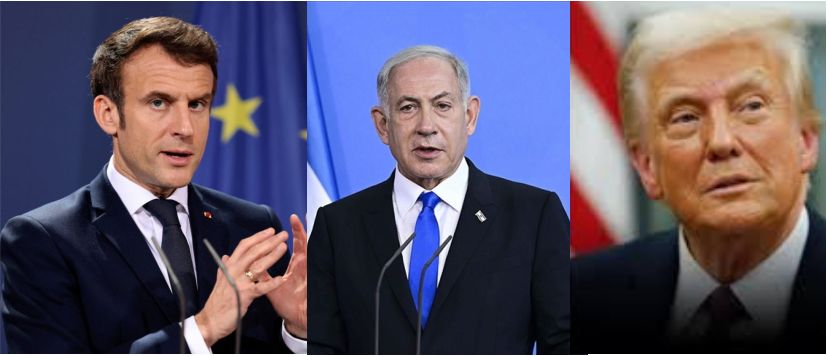
The evolving conflict involving Iran, the United States, and Israel has entered a new phase marked not just by military escalation, but by sharply divergent political messaging from key global actors. Statements from Emmanuel Macron, Donald Trump, and Israeli leadership reveal a fractured strategic landscape - one that is increasingly difficult to interpret and potentially more dangerous because of its contradictions.
At the heart of the confusion lies a simple question: Is the war nearing its end, or expanding into a broader regional confrontation?
Macron’s Position: NATO Unity and Diplomatic Realism
President Emmanuel Macron has sought to position Europe as a stabilizing force amid rising tensions. Defending NATO against Trump’s renewed threats of U.S. withdrawal, Macron emphasized the alliance’s importance in maintaining global security.
More notably, Macron argued that securing the Strait of Hormuz - a critical artery for global oil supply - would be impossible through unilateral force. Instead, he insisted that any sustainable solution would require coordination with Iran itself, but only after a ceasefire is achieved.
This stance reflects a broader European doctrine: de-escalation first, diplomacy second, and collective security always. Macron’s comments suggest that Europe is wary of a prolonged conflict that could destabilize energy markets and draw in additional actors.
Trump’s Narrative: War ‘Nearing Completion’
In stark contrast, Donald Trump has projected confidence, declaring that the U.S. war effort against Iran is “nearing completion” and asserting that “we have all the cards.”
This messaging aligns with Trump’s long-standing approach to foreign policy, which emphasizes decisive action and the projection of strength. By framing the conflict as nearing its end, Trump appears to be signaling both domestic and international audiences that U.S. objectives are being achieved.
However, this narrative raises critical questions. If the war is indeed close to completion, why do hostilities appear to be intensifying? And what constitutes “victory” in a conflict as complex as this?
Israel’s Escalation: Tactical Success, Strategic Risk
Adding another layer to the situation is Israel’s continued military campaign against Iranian targets. Israeli forces have reportedly launched multiple waves of attacks, claiming to have killed a top Hezbollah commander linked to Iran. Aljazeera
For Israel, the objective is clear: to degrade Iran’s military capabilities and limit its influence in the region. The targeting of Hezbollah figures underscores the broader scope of the conflict, which extends beyond Iran’s borders into proxy networks across the Middle East.
While these operations may yield tactical gains, they also increase the risk of escalation. Hezbollah, backed by Iran, could retaliate, potentially opening new fronts in the conflict.
Reconciling the Contradictions
Taken together, the positions of Macron, Trump, and Israel present a confusing picture. Macron is advocating for a ceasefire and cooperation with Iran, suggesting that long-term stability requires engagement rather than confrontation. Trump, on the other hand, is declaring imminent success, implying that military objectives are close to being achieved. Meanwhile, Israel is intensifying its attacks, signaling that the conflict is far from over.
These narratives are not just different - they are fundamentally at odds. One possible explanation is that each actor is operating with distinct priorities. For Europe, the focus is on stability and economic security. For the United States, particularly under Trump’s framing, the emphasis is on demonstrating strength and achieving decisive outcomes. For Israel, the priority is immediate security and the neutralization of perceived threats.
The NATO Question: Unity Under Strain
Macron’s defense of NATO highlights a growing concern about the alliance’s cohesion. Trump’s repeated threats to withdraw the United States from NATO have raised doubts about the future of transatlantic security cooperation.
If the U.S. were to reduce its commitment to NATO, Europe would face significant challenges in maintaining its security architecture. Macron’s remarks can therefore be seen as both a defense of the alliance and a warning about the consequences of its potential fragmentation.
The Iran conflict adds urgency to this issue. A divided NATO would struggle to respond effectively to global crises, increasing the risk of instability.
Energy Markets and the Strait of Hormuz
The Strait of Hormuz remains a central concern. Any disruption to this vital shipping lane could have immediate and severe consequences for global energy markets.
Macron’s insistence that the strait can only be secured in coordination with Iran reflects an understanding of the region’s complexities. Military control alone may not be sufficient to guarantee safe passage, particularly if Iran retains the capacity to disrupt shipping.
This perspective contrasts with more aggressive approaches that prioritize military dominance over diplomatic engagement.
The Risk of Miscalculation
Perhaps the most dangerous aspect of the current situation is the risk of miscalculation. Conflicting messages from major powers can create uncertainty, increasing the likelihood of unintended escalation.
If one actor interprets another’s actions or statements incorrectly, it could trigger a chain reaction that expands the conflict. In a region already fraught with tensions, such risks are particularly high.
The combination of military activity and inconsistent messaging creates a volatile environment where the margin for error is slim.
What Does ‘Victory’ Look Like?
A key issue underlying the confusion is the lack of a clear definition of victory. For Trump, victory may be framed in terms of military success and deterrence. For Israel, it may involve weakening Iran’s regional influence. For Europe, success may be measured by the restoration of stability and the avoidance of wider conflict.
These differing definitions make it difficult to assess the trajectory of the war. Without a shared understanding of objectives, coordination among allies becomes challenging.
Conclusion: A Conflict Without Clarity
The current phase of the Iran war is characterized by a paradox: increasing military activity alongside claims that the conflict is nearing its end.
Macron’s call for diplomacy, Trump’s assertion of impending victory, and Israel’s continued strikes illustrates the complexity of the situation. Each narrative reflects a different perspective, shaped by distinct priorities and strategic calculations.
For the international community, the challenge is to navigate these contradictions and find a path toward de-escalation. Without clear coordination and communication, the risk is that the conflict will not only continue but expand.
In the end, the confusion surrounding the Iran war may be as dangerous as the conflict itself.