Hong Kong Tiananmen Activists Convicted in Landmark National Security Trial
Hong Kong has convicted Tiananmen vigil organisers Lee Cheuk-yan and Chow Hang-tung of inciting subversion under the national security law, in a landmark case over free expression and political dissent.
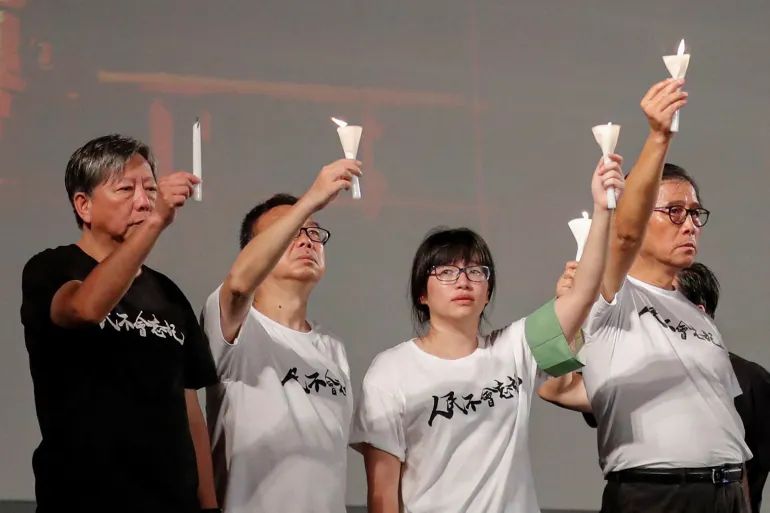
A Hong Kong court has convicted two prominent pro-democracy activists who organised annual vigils commemorating the 1989 Tiananmen Square crackdown, finding them guilty of “inciting subversion” under the city's national security law.
The High Court on Friday, August 21, found Lee Cheuk-yan, 69, and Chow Hang-tung, 41, guilty after a closely watched trial that has become a major test of the limits of political expression and historical remembrance in Hong Kong.
Both activists were former leaders of the now-disbanded Hong Kong Alliance in Support of Patriotic Democratic Movements of China, the organisation that for decades organised candlelight vigils remembering those killed when Chinese authorities violently suppressed pro-democracy demonstrations around Beijing's Tiananmen Square in June 1989.
The two defendants had pleaded not guilty. They now face a maximum sentence of 10 years in prison, although sentencing will take place later. A third defendant in the case, former Alliance chairman Albert Ho, pleaded guilty earlier. (AP News)
Court says activists sought to undermine state power
The three-judge panel concluded that Lee and Chow's activities went beyond peaceful remembrance and amounted to an attempt to undermine China's political system.
At the centre of the prosecution's case was the Alliance's longstanding call to “end one-party dictatorship” in China.
The court ruled that the slogan demonstrated an intention to undermine the authority of the Chinese Communist Party and the political system established under China's constitution. Judges said the defendants had sought to encourage others to participate in activities aimed at subverting state power. (Reuters)
The verdict illustrates the much broader transformation in Hong Kong since Beijing imposed its national security law in 2020 following the huge pro-democracy demonstrations that rocked the territory in 2019.
Tiananmen vigils were once a symbol of Hong Kong's freedoms
For more than three decades, Hong Kong was the only place on Chinese soil where large-scale public commemorations of the Tiananmen crackdown were permitted.
Every June 4, tens of thousands of people traditionally gathered at Victoria Park to light candles, sing songs and remember the victims of the 1989 crackdown.
The vigils became one of the clearest symbols of the freedoms that distinguished Hong Kong from mainland China under the “one country, two systems” arrangement established when Britain handed the territory back to China in 1997.
That tradition effectively ended in 2020, when authorities banned the annual vigil, initially citing public-health restrictions during the COVID-19 pandemic. Subsequent national security measures prevented the Alliance from continuing its activities.
The Alliance was eventually disbanded in 2021 after authorities demanded information about its operations.
Activists rejected allegations of subversion
Throughout the trial, Lee and Chow argued that their actions represented peaceful advocacy and the exercise of freedom of expression rather than an attempt to overthrow the government.
Chow, a lawyer who represented herself in court, argued that remembering the victims of Tiananmen and advocating democratic reform should not be treated as criminal activity.
Lee, a veteran labour activist and former lawmaker, similarly denied that he had hostile intentions towards China. He maintained that his advocacy was motivated by concerns about the country's political system and the welfare of its people.
The defence effectively placed Hong Kong's traditional freedoms at the heart of the proceedings, arguing that the case was about whether peaceful political speech could be treated as a national-security offence.
National security law changes Hong Kong's political landscape
The convictions are among the latest consequences of Hong Kong's national security legislation.
Beijing imposed the original National Security Law in June 2020, criminalising offences including secession, subversion, terrorism and collusion with foreign forces.
The legislation was introduced after months of mass protests in 2019 demanding greater democratic freedoms and opposing proposed extradition law.
Hong Kong authorities and Beijing have defended the national security framework as necessary to restore stability and protect the territory from threats to national security.
Critics, however, argue that the legislation has been used to dismantle Hong Kong's pro-democracy movement and suppress legitimate political dissent.
The Tiananmen case has become particularly sensitive because the defendants were not accused of violence. Instead, prosecutors relied heavily on their political statements, advocacy and organisational activities. (The Guardian)
A landmark case for freedom of expression
Human rights organisations have strongly criticised the verdict.
Amnesty International described the convictions as “dismaying” and argued that the national security law was being used to punish people for peacefully remembering one of the darkest episodes in modern Chinese history.
The organisation said Hong Kong had once been unique within China because residents could publicly commemorate the Tiananmen crackdown, but that this freedom had effectively disappeared. (Amnesty International)
The verdict has therefore raised concerns over what activities remain permissible for civil society groups, activists and ordinary citizens who wish to discuss politically sensitive historical events.
International observers closely followed the trial
The proceedings attracted international attention, with diplomats from countries including the United States and the European Union observing the case.
The trial has been viewed internationally as another important indicator of the state of civil liberties and judicial independence in Hong Kong.
Critics say the prosecution of Tiananmen vigil organisers demonstrates how far the territory's political environment has changed since the 1997 handover.
For decades, Hong Kong was widely regarded as a place where Chinese citizens could exercise freedoms that were unavailable on the mainland.
The criminalisation of the organisers of an event dedicated to remembering Tiananmen therefore carries considerable symbolic importance.
The case and Hong Kong's shrinking civil society
The Alliance's dissolution is part of a much wider decline in Hong Kong's civil society.
Several prominent pro-democracy organisations have disbanded since 2020, while numerous politicians, activists and campaigners have been arrested, prosecuted or jailed.
The national security crackdown has also affected independent media organisations and political groups.
Reuters reported that Lee, Chow and Ho were charged in 2021 with inciting subversion, an offence carrying a maximum penalty of 10 years' imprisonment. The three had already spent years in custody before the current verdict.
The case has therefore become emblematic of the pressure faced by Hong Kong's former opposition movement.
Chow and Lee could face up to 10 years
Following Friday's convictions, the immediate question is the punishment the court will impose.
Both Lee and Chow face up to 10 years in prison, although the final sentence will depend on the court's assessment of their individual circumstances and the seriousness of their offences.
The court has yet to announce the sentence date.
Their prolonged detention means that both activists have already spent considerable time in custody since their arrests.
Albert Ho, the third defendant, pleaded guilty earlier in the proceedings, potentially allowing him to receive a reduced sentence. (AP News)
Beijing and Hong Kong defend the national security approach
Hong Kong authorities have consistently rejected claims that the national security law is intended to suppress ordinary political expression.
Officials argue that residents remain free to criticise government policies as long as they do not cross the legal boundaries established by national security legislation.
From the government's perspective, the slogan calling for an end to one-party rule was not merely political commentary but evidence of an effort to undermine China's constitutional order.
The court's ruling has now established a legal interpretation that could have implications for other political activists and organisations.
A powerful symbol of Hong Kong's transformation
The conviction of Lee Cheuk-yan and Chow Hang-tung is significant well beyond the two individuals involved.
Their prosecution concerns the activities of an organisation that once attracted tens of thousands of people to one of Hong Kong's most important annual public gatherings.
The disappearance of that vigil and now the imprisonment of some of its leading organisers illustrates the dramatic transformation of Hong Kong's political environment.
For supporters of the defendants, the case represents the criminalisation of peaceful remembrance and democratic advocacy.
For Hong Kong authorities, it demonstrates the enforcement of laws designed to protect national security and prevent challenges to China's political system.
The disagreement reflects the central tension surrounding Hong Kong since 2020: how to balance national security with the freedoms and civil liberties that were once regarded as defining features of the territory.
As Lee and Chow await sentencing, their convictions are likely to remain a major focus of international debate over Hong Kong's political future.
The verdict also means that the annual Tiananmen vigil, once a defining symbol of Hong Kong's relative freedom, has become part of a very different story-one about the shrinking space for dissent, political organisation and public remembrance under the city's national security regime.