Flight Recorders Recovered from Amazon Cargo Plane Crash as NTSB Probes Miami Runway Disaster
Investigators have recovered the flight data and cockpit voice recorders from the Amazon cargo plane crash at Miami airport that killed five people as the NTSB begins its probe.
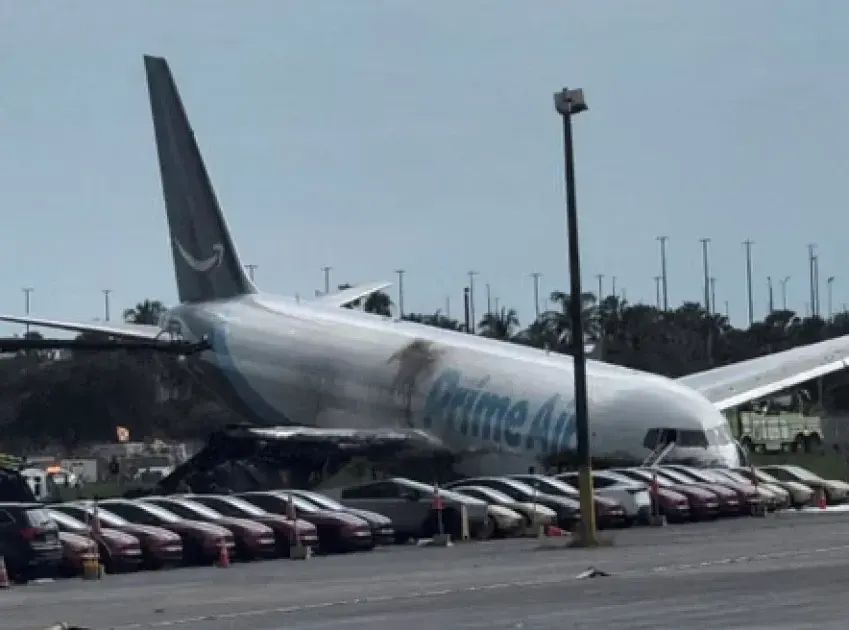
US investigators have recovered the flight data recorder and cockpit voice recorder from the Amazon cargo plane that overran a runway at Miami International Airport, marking a crucial step in the investigation into a crash that killed five people on the ground.
The National Transportation Safety Board (NTSB) said both recorders were recovered from the Boeing 767 cargo aircraft and were being transported to the agency's headquarters in Washington for downloading and analysis. Investigators hope the devices will provide critical information about what happened during the aircraft's final approach and landing. (Reuters)
The aircraft, operated by 21 Air LLC on behalf of Amazon Prime Air, crashed on Sunday, September 6, after overrunning Runway 30 at Miami International Airport. It travelled approximately 1,300 feet beyond the paved runway, striking airport equipment and vehicles before coming to a halt. Five people were killed and at least five others were injured.
Black Boxes Could Provide Critical Answers
Flight recorders, commonly known as "black boxes," are among the most important pieces of evidence in a major aviation accident.
The flight data recorder (FDR) captures technical information about an aircraft's operation, potentially including airspeed, altitude, heading, engine performance, flight-control inputs and other parameters.
The cockpit voice recorder (CVR) records cockpit conversations and other sounds that can help investigators understand what the crew was seeing, discussing and doing during the final stages of a flight.
In the Miami investigation, the recorders could help establish the aircraft's speed, touchdown characteristics, braking performance and crew actions during the landing.
NTSB Chairwoman Jennifer Homendy said investigators already have some speed information from other sources but want to compare it with the flight data recorder before releasing conclusions. (CBS News)
However, recovering the recorders does not mean investigators have immediately determined the cause of the accident. The devices must first be examined, downloaded and analysed alongside hundreds of other pieces of evidence.
What Happened to the Amazon Cargo Plane?
The aircraft was a Boeing 767-33A manufactured in 1994 and operated by Miami-based 21 Air under contract to Amazon.
It was on its third flight of the day and was returning to Miami from San Juan, Puerto Rico, when it overran the runway during landing.
According to the NTSB, the aircraft first struck navigational equipment before hitting a white Ford Econoline van belonging to a contracted airport cleaning company.
Seven people were inside the van at the time.
The aircraft then breached the airport's perimeter fence and struck a Toyota SUV travelling on a public road. It continued into a grassy area and crossed another fence near a location where Tesla robotaxis were parked.
The aircraft eventually stopped approximately 1,300 feet beyond the paved runway.
All five people killed in the crash were occupants of the two vehicles struck by the aircraft, according to the NTSB. The two pilots survived the accident.
NTSB Examines Multiple Possible Factors
Investigators have not identified a definitive cause of the crash.
Instead, the NTSB has established specialist teams to examine several areas, including human performance, aircraft systems, engines, air traffic control, aircraft performance, structures, meteorology and airport survival factors.
One major question is why the aircraft failed to stop on the runway.
Investigators will examine its speed, touchdown point, braking performance and whether the crew could have safely aborted the landing through a go-around.
Weather conditions will also be scrutinised. Reports indicate that stormy weather and strong winds were in the Miami area around the time of the accident.
The NTSB is expected to compare weather data with the aircraft's recorded performance to determine whether wind, rain or other atmospheric conditions affected the landing.
Importantly, investigators have not concluded that weather, pilot actions or mechanical problems caused the crash.
Runway Safety System Also Under Review
Another significant aspect of the investigation is the absence of an Engineered Materials Arresting System, or EMAS, at the end of the runway.
EMAS consists of specially designed crushable material installed beyond a runway that can slow and stop an aircraft during an overrun.
The NTSB said investigators would examine whether an EMAS could have changed the outcome of the Miami accident. However, Homendy stressed that such systems are not required at every airport.
The investigation will therefore consider the airport's runway configuration and safety infrastructure alongside the aircraft and crew.
The question is not simply why the aircraft left the runway, but also whether anything could have prevented the subsequent collision with vehicles and reduced the loss of life.
Investigators Yet to Interview Crew
Despite recovering the black boxes, investigators have not yet completed interviews with the flight crew.
Homendy said the NTSB wants to interview the pilots as part of the investigation, but recovery operations and access to the damaged aircraft remain priorities.
The agency has deployed a 32-member investigation team to Miami. Investigators are still documenting the crash site, collecting evidence and dealing with fuel and debris around the aircraft.
Homendy described the crash site as one of "utter devastation", with aircraft debris, vehicle components, damaged airport equipment and fencing spread across the area.
She also said the NTSB would not determine probable cause while investigators are still at the crash scene. The immediate objective is to preserve and collect evidence that could disappear or deteriorate.
Amazon and 21 Air Under Investigation
The relationship between Amazon and 21 Air will also form part of the investigation.
Although the flight operated as an Amazon Prime Air cargo service, the aircraft was operated by 21 Air under a contractual arrangement.
The NTSB said investigators would examine the responsibilities of both companies, including contractual arrangements, safety provisions and operating policies.
The aircraft's age and ownership history will also be reviewed. The Boeing 767 was manufactured in 1994 and subsequently converted for cargo operations.
Its age alone does not establish that the aircraft had a mechanical or maintenance problem, but investigators will examine its maintenance records and technical history as part of the standard accident investigation.
Crash Disrupts Miami Airport Operations
The crash also caused significant disruption at Miami International Airport, one of the United States' busiest aviation hubs.
Several runways were temporarily closed while emergency crews responded to the accident and investigators began documenting the scene. Flights resumed, but delays and cancellations affected passengers during the busy Labor Day travel period. (Reuters)
The investigation could keep parts of the airport under restrictions as debris is removed and investigators complete their work.
The NTSB has also appealed to members of the public who may have photographs or videos of the aircraft's approach or crash to provide them to investigators.
What Happens Next?
The recovery of the flight recorders represents an important milestone, but it is only the beginning of a much larger investigation.
Specialists will download the information, examine the aircraft's systems and compare the recorded data with radar information, air-traffic-control communications, weather reports, eyewitness videos and physical evidence from the runway.
Investigators will also reconstruct the aircraft's final moments to establish precisely what happened between its approach to Miami and its eventual stop more than 1,000 feet beyond the runway.
The final NTSB report could take months or longer to complete.
For now, the recovery of the black boxes gives investigators an important source of objective evidence as they seek answers to one central question: Why did the Amazon cargo plane fail to stop on the runway, and could the tragedy have been prevented?
The answers could have implications not only for Amazon and 21 Air but also for runway safety, cargo-aircraft operations and airports around the world.