Elon Musk, Jensen Huang Among Top CEOs Joining Trump on High-Stakes China Trip
Tesla CEO Elon Musk and Nvidia chief Jensen Huang are among several American business leaders accompanying President Donald Trump on a major diplomatic trip to China aimed at boosting trade and AI cooperation.
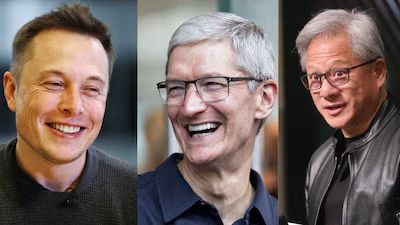
U.S. President Donald Trump has arrived in China for a highly anticipated summit with Chinese President Xi Jinping, accompanied by some of America’s most powerful business leaders, including Tesla and SpaceX CEO Elon Musk and Nvidia CEO Jensen Huang.
The visit, described by analysts as one of the most significant U.S.-China diplomatic engagements in years, is expected to focus heavily on trade, artificial intelligence, semiconductor exports, tariffs, aviation deals, and broader economic cooperation between the world’s two largest economies. (Reuters)
Trump landed in Beijing on Wednesday alongside a high-profile delegation that also reportedly includes Apple CEO Tim Cook, BlackRock CEO Larry Fink, Goldman Sachs CEO David Solomon, Blackstone chairman Stephen Schwarzman, Boeing CEO Kelly Ortberg, and Citi CEO Jane Fraser. (The Guardian)
The two-day summit comes amid renewed tensions and negotiations over artificial intelligence dominance, semiconductor exports, and global supply chains. Trump has repeatedly stated that he wants China to “open up” more to American businesses and reduce trade restrictions that have affected U.S. companies operating in the Chinese market.
In a social media post before arriving in Beijing, Trump pushed back against earlier media reports suggesting Jensen Huang had not been invited on the trip. The U.S. president confirmed Huang was aboard Air Force One and said he looked forward to discussing opportunities for American companies during the summit with Xi Jinping. (The Economic Times)
Reuters reported that Trump and his delegation received a lavish state welcome upon arrival in Beijing as preparations began for meetings expected to shape future economic relations between Washington and Beijing.
The inclusion of Musk and Huang has drawn global attention because both executives sit at the center of increasingly sensitive U.S.-China technology relations.
Musk’s electric vehicle company Tesla depends heavily on the Chinese market, where its Shanghai Gigafactory remains one of the company’s largest production hubs. However, Tesla has recently faced increasing competition from Chinese EV manufacturers, particularly BYD, which has overtaken Tesla in several global electric vehicle sales metrics. (Business Insider)
Meanwhile, Nvidia’s Jensen Huang has become one of the most influential figures in the global AI boom. NVIDIA’s advanced AI chips remain central to worldwide artificial intelligence development, but export restrictions between the United States and China have complicated the company’s ability to do business in the Chinese market.
Analysts believe Huang’s late inclusion in Trump’s delegation signals the growing importance of semiconductor diplomacy and AI competition in U.S.-China relations.
According to Reuters, Chinese technology firms have reportedly expressed optimism that Trump’s visit could help unlock stalled negotiations surrounding Nvidia’s H200 AI chips, which Chinese companies have sought access to for years.
The trip also reflects Trump’s broader strategy of involving American corporate leaders directly in foreign diplomacy. Several observers noted that the president appears eager to secure major commercial agreements during the visit, including aircraft purchases, AI cooperation frameworks, agricultural deals, and technology investment commitments. (New York Post)
Business Insider reported that Musk and Huang even traveled together aboard Air Force One after Huang reportedly joined the delegation during a refueling stop in Anchorage, Alaska. Musk later shared updates from the flight using Starlink internet services.
The summit is also politically significant because it marks the first visit by a sitting U.S. president to China in nearly a decade. The trip had originally been scheduled for April but was delayed due to geopolitical tensions linked to the Middle East conflict earlier this year.
Experts say the stakes for the Beijing summit are extremely high.
Relations between the United States and China have remained strained over issues including Taiwan, trade imbalances, semiconductor restrictions, military competition, cybersecurity, and regional influence in Asia. However, both nations also remain deeply economically interconnected, especially in technology manufacturing and consumer markets. (Wikipedia)
Trump has indicated that “opening up” China’s economy will be one of his main requests during discussions with Xi Jinping. The president also hopes to encourage additional Chinese purchases of American products and strengthen opportunities for U.S. companies operating in China.
For Elon Musk, the visit could provide an opportunity to stabilize Tesla’s position in China at a time when the company faces growing pressure from local rivals and changing consumer preferences. Analysts say maintaining favorable relations with Beijing remains crucial for Tesla’s long-term global ambitions.
For Jensen Huang and Nvidia, the stakes may be even higher. NVIDIA’s AI chips are viewed as essential infrastructure in the global race for artificial intelligence leadership, making Huang one of the most influential corporate figures involved in the summit. (Bloomberg)
Social media reactions to the delegation have been mixed, with some observers praising the effort to improve economic cooperation while others questioned whether closer business ties could weaken U.S. pressure on China over national security and technology concerns.
Still, many analysts agree that the presence of America’s top corporate executives underscores the enormous economic importance of the relationship between Washington and Beijing.
As meetings between Trump and Xi begin, the world will be watching closely to see whether the summit produces concrete agreements on trade, AI technology, semiconductor exports, and investment cooperation - issues likely to shape the future global economy for years to come.