China’s AI Film Experiment Faces a Box-Office Test
China’s first fully AI-generated feature film has opened in cinemas amid disappointing advance ticket sales, raising questions about whether artificial intelligence can become a commercially successful force in the global film industry.
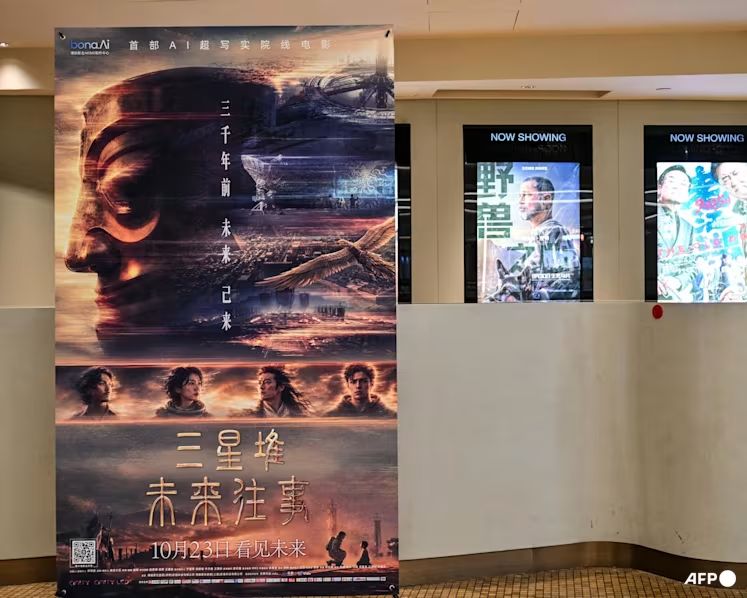
The science-fiction thriller, Sanxingdui: Future Past, debuted nationwide on Friday, October 23, 2026, marking a significant milestone for China's expanding AI entertainment sector. However, the film's early financial performance suggests that technological innovation alone may not be enough to attract cinema audiences.
According to ticketing platform Maoyan, advance sales stood at approximately 80,000 yuan, or about $11,980, on Friday morning. The platform's forecast placed potential total box-office revenue below 150,000 yuan, a small fraction of the reported production cost of more than 10 million yuan, equivalent to approximately $1.5 million. More than 10,000 screenings were scheduled for opening day.
What Is Sanxingdui: Future Past About?
Produced by Chinese film company Bona Film Group, Sanxingdui: Future Past combines ancient Chinese civilisation with futuristic science fiction, exploring the relationship between humanity and artificial intelligence.
The story draws inspiration from the archaeological mysteries surrounding Sanxingdui, an ancient civilisation in Sichuan Province known for its distinctive bronze masks, monumental sculptures and other extraordinary artefacts.
In the film's futuristic narrative, mysterious symbols discovered on ancient bronze objects contain a binary code that appears impossible for their historical period. The story then moves into a future where superintelligent AI spreads across the world, with humans increasingly surrendering their decisions and judgement to algorithms.
The film uses AI-generated characters, voices and backgrounds rather than conventional live-action actors. Its production took more than two years, involving nearly 100 people, according to Bona Film Group.
The project demonstrates that AI filmmaking requires more than simply generating attractive images. Maintaining consistent characters, facial expressions, lighting and environments throughout a feature-length production presents substantial technical challenges.
The production team used an integrated creative workflow to manage scripts, storyboards, characters and visual assets. Human professionals continued to oversee creative direction and artistic decisions.
The film therefore represents a collaboration between AI systems and human expertise rather than an entirely autonomous filmmaking process.
Why Are Ticket Sales So Weak?
The film's disappointing advance sales suggest that the novelty of AI-generated cinema has not automatically translated into strong consumer demand.
Although thousands of screenings were scheduled, reported advance revenue remained low relative to the production budget. The figures are early indicators rather than final box-office results, but they highlight the commercial uncertainty surrounding AI-generated feature films.
Audience reactions have also raised questions about the quality of AI-generated storytelling and visuals.
Iris Yang, who attended a free preview screening, told Agence France-Presse that she would not have paid to watch the film because she was dissatisfied with its quality.
She suggested that AI-generated productions would need to match the theatrical experience of Hollywood's Avatar franchise before she would be willing to pay for them.
Independent AI filmmaker Zhang Jun similarly cautioned that viewers would not automatically purchase tickets simply because a film had been made using artificial intelligence.
These reactions suggest that audiences continue to judge films according to familiar standards: compelling stories, believable characters, strong visual effects and an engaging cinema experience.
China’s AI Video Boom Has Not Guaranteed Cinema Success
The weak opening comes at a time when AI-generated entertainment is gaining considerable popularity in China.
On Douyin, the Chinese equivalent of TikTok, AI-generated short dramas attracted more than 200 billion views during September 2026, according to AFP.
That figure illustrates the enormous reach of AI-produced entertainment in short-form digital formats. However, the popularity of free or easily accessible online videos does not necessarily mean consumers will pay to watch a feature-length AI film in cinemas.
Cinema audiences face a different purchasing decision. They must consider ticket prices, the quality of the production and whether the film offers an experience worth leaving home for.
Tickets for Sanxingdui: Future Past ranged from 20 to 90 yuan, according to reporting by PUNCH Newspapers. Some social media users suggested that AI-generated films might attract larger audiences if distributed free through online platforms.
The contrast highlights a crucial commercial challenge for AI studios: building an audience is not the same as generating revenue.
For producers, the next stage will involve identifying distribution models that can turn AI's production capabilities into sustainable entertainment businesses.
AI Filmmaking Raises Questions About Jobs and Creativity
Beyond its box-office performance, the film arrives amid a wider debate about the future of employment and creative work.
In Hollywood, actors, writers and other film professionals have expressed concerns about AI systems potentially replacing human workers or reproducing creative material without appropriate permission.
Virtual performers such as Tilly Norwood have intensified discussions about whether computer-generated personalities could eventually compete with human actors for commercial roles.
China's AI entertainment industry is also expanding rapidly, supported by technology investment and efforts to develop new production methods. Reuters reported in September that Chinese cities and industrial parks were offering incentives, computing resources and other support to attract AI content creators.
However, the sector continues to face challenges involving copyright, originality, market saturation and the ability of AI productions to attract sustained audiences.
The future of AI filmmaking may consequently depend on how studios balance technological efficiency with human creativity, appropriate rights management and audience expectations.
What the Film Means for the Future of Cinema
Despite its disappointing advance sales, Sanxingdui: Future Past represents an important experiment in bringing AI-generated content to mainstream cinemas.
Its significance extends beyond whether it becomes a financial success. The project tests the technical feasibility of producing a feature-length film using AI throughout the visual production process and distributing it through conventional theatrical channels.
For established studios, AI could eventually help reduce the cost of certain production tasks, accelerate visual development and make complex scenes easier to create. Smaller filmmakers may also gain access to tools that previously required substantial budgets and specialised teams.
However, lower production barriers could also increase competition, making it more difficult for individual films to stand out in an already crowded entertainment market.
The film's early performance offers a reminder that technological innovation does not automatically create a successful entertainment product. Even as AI transforms how films are made, audiences still expect stories and cinematic experiences that justify their spending.
Ultimately, Sanxingdui: Future Past will be judged not only by its pioneering production process but also by its ability to connect with viewers.
China has demonstrated that an AI-generated feature can reach the big screen. Whether the experiment can develop into a profitable and sustainable filmmaking model remains an open question, one that the film's final box-office figures and audience reception will help answer.