Blue Origin Rocket Explodes on Florida Launch Pad in Major Setback for Jeff Bezos’ Space Company
A Blue Origin New Glenn rocket exploded during a hot-fire test at a Florida launch pad, dealing a major setback to Jeff Bezos’ space company as it competes with Elon Musk’s SpaceX.
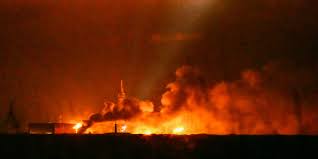
A massive explosion rocked Florida’s Space Coast after a Blue Origin New Glenn rocket erupted into a giant fireball during a hot-fire engine test, marking one of the most dramatic setbacks yet for Jeff Bezos’ ambitious space company.
The explosion occurred late Thursday night at Cape Canaveral Space Force Station in Florida, where Blue Origin engineers were conducting a static engine-firing test ahead of a planned satellite launch next week. (Ap.news)
Videos circulating online showed the enormous 321-foot rocket suddenly engulfed in flames moments after ignition, producing a towering mushroom cloud and lighting up the night sky across parts of central Florida.
The blast, which occurred at approximately 9 p.m. local time, shook nearby homes and was reportedly felt several miles away from the launch facility.
Blue Origin later confirmed the incident in a statement posted on social media, describing the explosion as an “anomaly” during the hot-fire test.
“We experienced an anomaly during today’s hot-fire test. All personnel have been accounted for. We will provide updates as we learn more,” the company stated.
Fortunately, no injuries or fatalities were reported.
Officials at Cape Canaveral Space Force Station confirmed that all workers and emergency personnel were safely evacuated before the test began, following standard rocket testing safety procedures.
The destroyed rocket was part of Blue Origin’s New Glenn programme, a multibillion-dollar heavy-lift launch system designed to compete directly with Elon Musk’s SpaceX Falcon Heavy and Starship programmes.
Named after legendary American astronaut John Glenn, the New Glenn rocket is central to Blue Origin’s long-term ambitions in commercial spaceflight, satellite deployment, and lunar exploration.
The rocket involved in the explosion was reportedly being prepared for a mission scheduled for early June that would have launched 48 internet satellites for Amazon’s Leo broadband constellation project, which is expected to rival SpaceX’s Starlink network.
The incident represents another painful delay for Blue Origin, which has already faced repeated technical and scheduling setbacks in the development of the New Glenn rocket.
Industry analysts say the latest explosion could delay future launches for months while investigators determine the root cause of the failure and assess the damage to the launch infrastructure.
Early footage from the scene suggested the rocket’s first stage was destroyed, while parts of the upper stage appeared to collapse into the inferno shortly after the blast.
Witnesses described the explosion as one of the most powerful rocket-related incidents seen in the United States in recent years. (Reuters)
Residents near Cape Canaveral reported hearing loud shockwaves and seeing the sky briefly turn orange from the intensity of the flames.
Local emergency services temporarily closed roads around the launch complex as firefighters and hazardous materials teams secured the area.
The Federal Aviation Administration (FAA) confirmed it has opened an investigation into the incident, while NASA officials said they were closely monitoring developments.
Blue Origin’s New Glenn rocket plays a significant role in several future NASA programmes, including components linked to the Artemis lunar missions aimed at returning astronauts to the moon.
Just days before the explosion, NASA had awarded Blue Origin a major lunar development contract worth approximately $188 million.
The explosion is therefore expected to trigger broader concerns about the timeline and reliability of upcoming missions tied to the company’s launch capabilities.
Jeff Bezos, founder of Amazon and owner of Blue Origin, reacted to the explosion in a post on X, formerly Twitter.
“It’s too early to know the root cause, but we’re already working to find it. Very rough day, but we’ll rebuild whatever needs rebuilding and get back to flying,” Bezos wrote.
The billionaire’s comments were widely shared across the space industry, with several aerospace executives and enthusiasts expressing support despite the dramatic failure.
Even Elon Musk, Bezos’ longtime rival in the private space race, reportedly responded sympathetically, remarking that “rockets are hard.”
The explosion comes at a critical time in the intensifying competition between Blue Origin and SpaceX.
While SpaceX has established itself as the dominant force in commercial space launches through repeated successful missions, Blue Origin has struggled to match the pace despite years of investment and development.
The New Glenn rocket was intended to become Blue Origin’s flagship orbital launch vehicle capable of carrying large payloads into space and supporting future deep-space missions.
Thursday’s explosion could now significantly impact on the company’s competitive position within the rapidly expanding commercial space industry.
Experts say static fire or hot-fire tests are among the most dangerous stages in rocket preparation because engines are ignited at full power while the vehicle remains anchored to the launch pad.
Such tests are designed to identify mechanical or fuel system problems before an actual launch.
However, catastrophic failures during these tests, while relatively rare, can cause devastating damage when large quantities of rocket fuel ignite simultaneously.
Space industry observers noted that the scale of the Blue Origin explosion bears similarity to previous launchpad accidents involving SpaceX and other aerospace companies during the testing phases of new rocket systems.
Despite the setback, analysts believe Blue Origin is unlikely to abandon the New Glenn programme due to the enormous financial and strategic investments already committed to the project.
The company is expected to begin a detailed technical review involving NASA, the FAA, and independent engineering teams in the coming days.
Meanwhile, launch schedules connected to Amazon’s satellite internet project and several planned NASA-related missions may now face significant delays.
The dramatic explosion has once again highlighted the enormous risks associated with modern spaceflight, even as private companies race to dominate the future of commercial and interplanetary exploration.
For Blue Origin, the road to recovery may now depend on how quickly investigators can determine what went wrong and whether the company can rebuild confidence in its flagship rocket programme.