Amaechi Accuses Tinubu of Abusing Him During Port Harcourt Visit, Says President Was “Talking Nonsense”
Former Rivers State Governor Rotimi Amaechi has accused President Bola Tinubu of verbally attacking him during a recent visit to Port Harcourt, escalating political exchanges ahead of Nigeria’s 2027 elections.
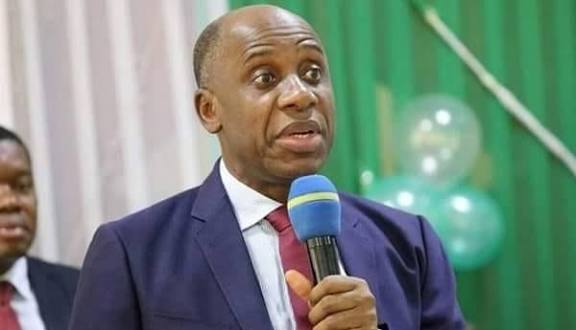
Former Rivers State Governor and African Democratic Congress (ADC) chieftain, Rotimi Amaechi, has accused Senate President Godswill Akpabio of verbally attacking him during a recent visit to Port Harcourt, Rivers State, while also alleging that Akpabio introduced a controversial 50 per cent deduction from payments to contractors handling projects for the Niger Delta Development Commission (NDDC).
Amaechi made the allegations on Saturday, November 14, 2026, during an ADC political rally at the Tafawa Balewa Stadium in Bauchi State. His comments have added another dimension to the growing political exchanges involving prominent figures from the South-South region ahead of Nigeria’s 2027 general elections.
Addressing supporters at the rally, the former minister of transportation reportedly referred to Akpabio’s recent presence in Port Harcourt and accused him of making disparaging remarks about him.
“Akpabio, who was in Port Harcourt the other day abusing me and talking nonsense, ask him who introduced 50 per cent from contractors in NDDC. It was Akpabio,” Amaechi said.
The former governor’s statement linked his personal disagreement with the Senate President to a serious allegation concerning the management of funds meant for development projects in the Niger Delta.
Amaechi makes serious allegation against Akpabio
At the centre of Amaechi’s accusation is the claim that Akpabio introduced a system under which contractors handling NDDC projects were allegedly required to surrender 50 per cent of their payments.
The former governor did not provide detailed documentation at the rally to substantiate the allegation. However, he directly challenged Akpabio to explain the alleged deductions and his purported role in introducing the practice.
The accusation is significant because the NDDC is responsible for implementing development programmes across the oil-producing states of the Niger Delta, a region that has continued to struggle with inadequate infrastructure, environmental degradation, unemployment and widespread poverty.
The commission manages projects involving roads, bridges, healthcare facilities, education and other interventions intended to improve living conditions in host communities.
If established, allegations of substantial deductions from contractors’ payments could raise questions about procurement transparency, project costs and the quality of infrastructure delivered across the region.
However, Amaechi’s claim remains an allegation and should not be treated as an established finding of wrongdoing without supporting evidence or an independent investigation.
Akpabio demands evidence
Akpabio has responded to the allegation by challenging Amaechi to provide documentary evidence, including contract documents, payment records and details of the transactions allegedly affected.
In a statement issued on Sunday, November 15, through his Special Adviser on Media and Publicity, Eseme Eyiboh, the Senate President described the allegation as weighty and said the former Rivers governor had not supplied evidence to support it.
Akpabio reportedly asked Amaechi to identify the contractors involved, the specific projects, the dates of the alleged deductions and the payment arrangements through which the money was supposedly withheld.
He also challenged the former governor to submit any credible evidence to the appropriate investigative authorities rather than make accusations at political gatherings.
The Senate President argued that making an allegation before a political audience does not automatically establish its truth.
Akpabio also turned attention to Amaechi’s record as Rivers State governor between 2007 and 2015, raising questions about the controversial Port Harcourt monorail project and the state's malaria-free initiative.
His response effectively shifted the exchange beyond the alleged NDDC deductions to a broader debate about public accountability and the records of both politicians.
A growing political rivalry in the Niger Delta
The latest exchange reflects the increasingly confrontational political atmosphere surrounding influential politicians from Rivers State and the wider Niger Delta.
Amaechi, who served as Rivers State governor for eight years before becoming Minister of Transportation under former President Muhammadu Buhari, is now a prominent opposition figure in the ADC.
Akpabio, a former governor of Akwa Ibom State, currently occupies one of the country's most influential political offices as President of the Senate.
Both men have extensive political histories in the South-South region, making their public disagreements particularly significant in a region where questions about resource management, infrastructure development and political representation remain important.
The exchange also comes as political parties and their leading figures intensify preparations for the 2027 general elections.
Amaechi has recently been critical of the Tinubu administration, accusing it of failing to address economic hardship, insecurity and other national challenges.
He has also used ADC campaign platforms to promote the opposition party's ambitions, insisting that Nigerians should support a change of government.
2027 politics and the accountability question
The disagreement between Amaechi and Akpabio raises broader questions about the standard of accountability expected from public officials, particularly those who have occupied important positions in government.
The NDDC has long faced public scrutiny over project execution, abandoned contracts, procurement processes and the impact of development spending on communities across the Niger Delta.
Consequently, allegations involving deductions from contractors' payments are likely to attract attention from civil society organisations, development advocates and residents of the region.
For the allegations to move beyond political controversy, however, the relevant contracts, payment records and financial transactions would need to be examined by competent investigative institutions.
Akpabio's demand for documentary evidence places the responsibility on Amaechi to provide details that can be independently verified. At the same time, the Senate President's response has brought renewed attention to questions about the performance and accountability of political officeholders.
As the 2027 elections approach, Nigerians will be watching whether political exchanges of this nature produce verifiable information about public spending and governance or remain part of the increasingly heated contest for political influence.
For now, Amaechi's allegation and Akpabio's demand for evidence have opened another chapter in the political rivalry involving two prominent figures from the Niger Delta. The central question remains whether the claims about the NDDC will be supported by records and subjected to an independent investigation.